
Podcast: Play in new window | Download (Duration: 8:51 — 4.7MB) | Embed
Hello, everyone! My name is John McGrail, if you think the old wives’ tale of losing weight after age 40 being harder is bunk—well, you’re just wrong, and I believe that if you’re not learning, you’re not living. Today I’m going to be talking about my passion for a game that I hope I can persuade you to start or to keep playing your game.
So, what’s today’s fun fact? Between July 2013 and July 2014 activewear, or work out clothes, accounted for $33.7 billion dollars, approximately 16% of the apparel market. We’ve seen the age of “Athleisure” come upon us. Women especially are buying these clothes not with the intention of hitting the treadmill or yoga mat. They’re often wearing them because they’re…comfortable. Huh, waddayouknow?
Speaking of being comfortable in what you know, the Friday Forum is coming up quick—your chance to share what you have been learning. You can add your voice to the Friday Forum in several ways—by calling 3048372278 and leaving a voicemail, going to www.goldenspiralmedia.com/feedback and leaving your feedback by uploading an audio file, using the provided speakpipe widget, or you can type out an email and send it in that way.
Now, here’s what I learned yesterday:
I took a class in college. That’s not revolutionary I know; but, this kind of class was outside of my comfort zone for sure. I needed a physical education class in college and I thought, “well, why not?” Now, you need to understand some context. So, three easy points. First, I am so very non-athletically coordinated by nature. Secondly, I have had type 1 diabetes which means my body does not produce any insulin on its own. Insulin is the hormone that helps the cells in your body break down the sugars you eat so that your cells can turn it into energy. Without insulin the sugars build up and eventually start doing damage to your organs. My explanation is for anyone who may not know what diabetes actually is. For this kid growing up in the 1970’s the word diabetes caused teachers, coaches, and most adults panic when they heard it because there was not a lot of knowledge about the disease or how you can fairly easily manage it and still take part in organized sports. Folks like Jay Cutler, quarterback for the Chicago Bears, were a long way from coming on to the scene. Third point—I also deal with exercise-induced asthma. With most asthma sufferers the difficulty is getting air out, with me it’s the opposite of not being able to get sufficient air in so endurance anything, running, swimming, and the like are pretty much out.
So, I took the class in college. The class was great. It was not endurance draining and I could keep up. Nobody cared that I was type 1 diabetic because outside of letting the teacher know in the very beginning neither one of us brought it up again. The only hurdle left was my non-coordination! Well, let’s just say I’m still working on that one. But this class, it brought up the love of this game. It was exhilarating, it was exciting to feel even halfway accomplished at a sport, let’s be honest-it was a major win.
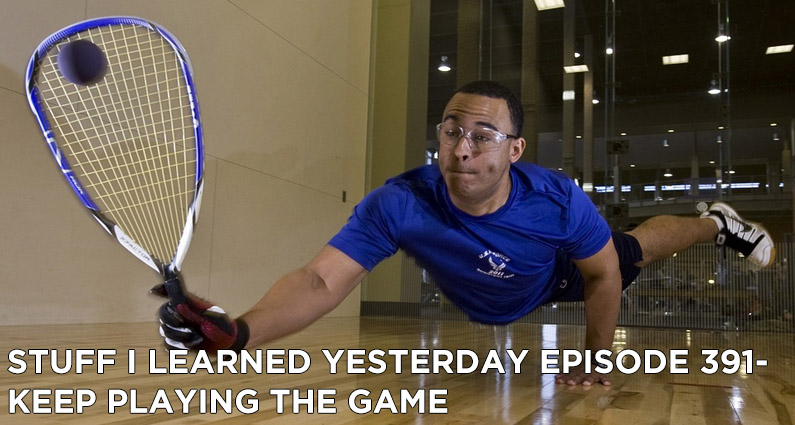
The game is played in an elongated cube. The cube is 40 feet long, 20 feet wide, and 20 feet high. There are lines on the floor of the cube that specify where certain plays are made. Other than that there are no markings anywhere else in the cube. The equipment needed is simple: a small strung racquet that is held in the hand, no longer than 22 inches from the bottom of the handle to the top of the racquet, a rubber hollowed-out ball, usually blue in color but there’s no color requirement, and eye protection is always advised. Simple so far, yes?
The game must have two opponents but can fit up to four. The cube gets a little claustrophobic with four, but it works…
It’s all about the play of the game. The play begins with the serve, always off of the front wall and it can hit no more than one side wall before it reaches the floor. The opponent can only have one bounce off the floor to strike the ball and have it hit the back wall for their play. The first one to have the ball hit the floor more than once or have the ball not reach the back wall is the loser of the rally. If the person serving wins the rally it’s their point. If it’s the opponent, then they win the right to serve and hopefully win points. The first player to 15 (winning by two, at least in Canadia) wins the game. While getting more complicated to explain, that’s really it. You’ve just learned 95% of what you need going into a cube for the first time.
Think about playing a game of pool in 3 dimensions holding a raquet instead of a pool cue. The idea is to figure out where the ball will be after you’ve placed it on the back wall and maybe it bounces off of a side wall, maybe the ceiling, and hopefully not hitting your opponent—or even yourself! As you gain more and more skill comes more and more speed with the ball traveling easily more than 100 mph after a smash hit against the back wall. It is a game of high emotions and those with short fuses are met with bent racquets as the players slam them into the walls or floor after missing a close shot. Or you are the highest of champions when you deflect your opponent’s shot and beyond reason it hits the back wall and dies into the floor. You are the mighty victor—of that instant. Then it’s time to serve and start the next point. The game is exhilarating, exhausting, and one of the biggest rushes I know. The game? Most of you already know but, for a few they still might not…It’s Raquetball.
Here’s what I learned: The games of life need you as a player. It’s too easy to sit back and say, “well, I’m not atletic,” or “I don’t have the very high priced wardrobe it takes to be in that yoga class.” Excuses. Of course there are very real physical limitations that people deal with; but, one of life’s greatest tragedies is not playing, not challenging, not pushing oneself to the next level of play. I’ve been playing at racquetball for more than 20 years and I’m not a phenomenal player by any means but I’m better than I was when I entered that class in Chapel Hill in 1990. I’ve tried to learn better serve techniques, I’ve played with some of the best in my area and gotten my dignity handed to me but I still learned something—mostly to get out of the way of greatness! In many ways I’m preaching to the choir here—if we here at SILY are not learning then we’re not living—that’s our mantra! It’s true in the cube just like anywhere else. So, what’s your field, your running path, your court, your playing space where the game needs you? I know it’s hard to get going sometimes, I know there are days where you’re going to have that dignity handed to you and I know there will be days when you’re the highest of champions. The question is what are you going to do with that learning?
I’m John McGrail, and this has been Stuff I Learned Yesterday.
Follow Golden Spiral Media on Twitter at GSMPodcasts and Facebook.com/GoldenSpiralMedia. To subscribe to Stuff I Learned Yesterday, visit GoldenSpiralMedia.com/subscribe. If you’ve enjoyed this episode of Stuff I Learned Yesterday, I would be grateful if you’d leave a review in iTunes by going to www.goldenspiralmedia.com/itunes.
Send in your contributions for this week’s Friday Forum. Head on over to https://www.goldenspiralmedia.com/feedback and use the form on that page to submit your written or audio message. You can also use the Speakpipe widget to record something using your devices microphone. And of course you can call our voice feedback line at 304-837-2278. We’d love to hear from you.
Join our Facebook Group at Facebook.com/groups/stuffilearnedyesterday.
You can Follow Golden Spiral Media on Twitter at GSMPodcasts and Facebook.com/GoldenSpiralMedia. If you’ve enjoyed this episode of Stuff I Learned Yesterday, I would be grateful if you’d leave a review in iTunes.
[sc:stuff]