
Podcast: Play in new window | Download (Duration: 15:05 — 9.0MB) | Embed
Is it possible that one of the biggest threats to your family’s health isn’t in the pantry or the medicine cabinet, but in the way dinner gets served? During my lifetime, a shift has been happening in millions of kitchens, one that researchers have been tracking for decades, and the numbers are more dramatic than I thought. Today I’m digging into what actually changed, what the research says it’s costing us, and tossing out a handful of simple questions that can turn an ordinary weeknight meal into something your kids will remember for the rest of their lives.
Welcome to Stuff I Learned Yesterday, this is episode #719, “Pull Up a Chair.” I’m Darrell Darnell, I love my stepmom’s homemade lasagna, and I believe that if you aren’t learning, you aren’t living.
I also love my wife’s made from scratch white chocolate chip cranberry cookies, but my favorite foods are not the focus of today’s story. This one is about a different kind of recipe, one that doesn’t involve an oven at all. It involves a table, some chairs, and showing up.
A few years ago, one of our kids came home from a friend’s house with a question I wasn’t expecting. She said, “Dad, why do we always eat dinner together? Nobody else does that.” When she asked me, I just kind of blinked at her because to me, eating dinner together wasn’t a decision. It was just what you did.
When I was growing up, my family gathered around the table every night. That’s where we ate. Not in the living room. Not standing at the counter. Not one person eating at five and another eating at eight because of practice. We sat down together and ate. When I’d stay the night with friends, same thing. When I’d stay with my grandparents, same thing. Some homes said a prayer before the meal, some didn’t, but every single one of them gathered the family at the table.
I never thought twice about it because I didn’t know there was another way to do it. Kari grew up the same way. So when we started our own family, we just kept doing what we’d always known. We didn’t sit down one day and decide “the Darnell family will now implement a nightly dinner policy.” It was simply in our DNA. You cook the food, you call everybody, everybody comes, everybody sits, everybody eats.
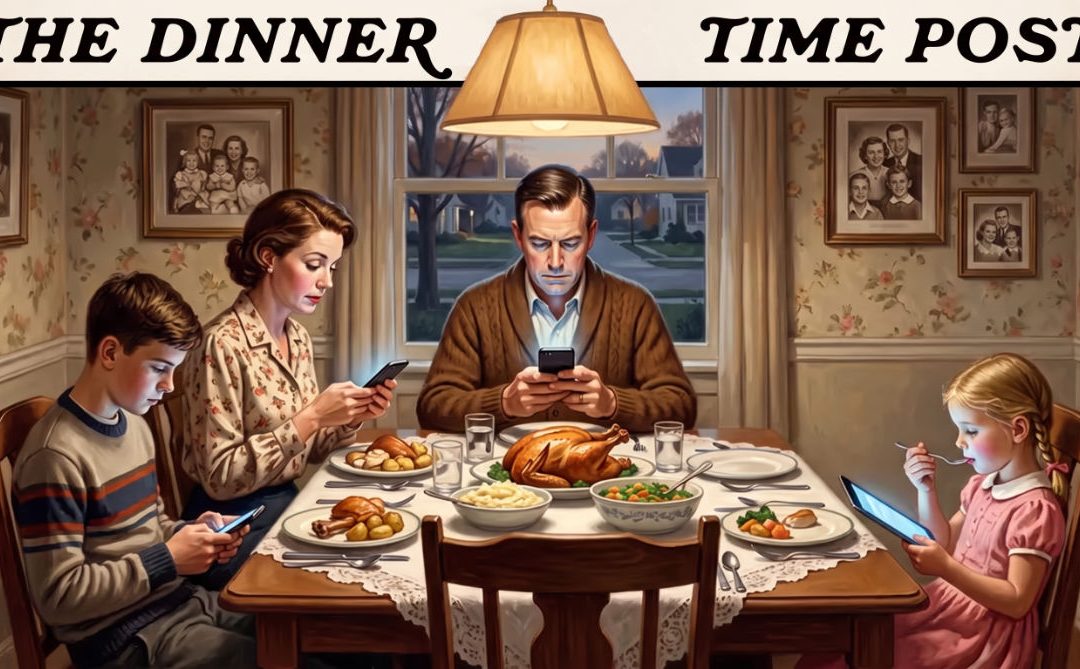
But as our kids got older and started spending more time at friends’ houses, they started noticing something we hadn’t noticed ourselves. They’d come home and tell us about dinner at so-and-so’s house. Everybody grabbed a plate whenever they were hungry and ate wherever they wanted. Some families ate in front of the TV, plates balanced on laps, nobody talking because the show was talking for them. Some kids said they couldn’t remember the last time their whole family sat down together on a regular weeknight.
Our kids started telling us we were different. Not in a bad way. More like they’d discovered we were doing something unusual, the way you’d discover your family says a word differently than everyone else. They said we might be the only family they knew who ate dinner together at the table every night.
That got me curious. Was this actually rare? Or were our kids just exaggerating, the way teenagers do when they want to make a point? So I went looking for the numbers and what I found surprised me.
Researcher Robert Putnam, who wrote the book “Our Kids,” used data from an annual survey called the DDB Needham Life Style Survey, which ran from 1975 to 2005. He found that the number of Americans who agreed with the statement “our whole family usually eats dinner together” dropped from roughly 80 percent in the mid-1970s to around 70 percent by the early 1990s. That’s the stretch when Kari and I were growing up.
The good news, according to a more recent analysis by researchers Scott Winship and Thomas O’Rourke at the American Enterprise Institute, is that the decline mostly leveled off after the mid-1990s. Family dinner didn’t keep sliding toward zero. It found a floor and mostly held there for the next thirty years.
There’s another way to look at this that I think is even more telling, because it asks people to look back across their whole childhood instead of just one year. A researcher named Dan Cox at the American Survey Center asked adults from different generations whether they had family meals every single day when they were growing up. Here’s what he found. Eighty four percent of the Silent Generation said yes. Fifty nine percent of Gen X said yes, and that’s the generation Kari and I belong to. For Millennials, it dropped to 46 percent. And for Gen Z, the generation our kids belong to, it was down to 38 percent. Eighty four percent down to thirty eight percent. That number was shocking to me. That’s the family table going from the default setting of American life to something a minority of kids experience every day.
Here’s the part that gives me hope. More recent surveys show the picture isn’t all doom and gloom. The Family Dinner Project, which has been tracking this for years, found that about 29 percent of families report eating together every single night, another 23 percent eat together four to six nights a week, and 16 percent manage two or three nights. And data from the National Center on Addiction and Substance Abuse at Columbia University, usually called CASA, found that 58 percent of teens report having dinner with their family at least five times a week, which is actually an increase from when they first started measuring this back in 1998.
So the table hasn’t disappeared. But it has shrunk, especially for the generation coming up behind us. And I think that shrinking matters more than most families realize. It’s one thing to say “family dinner is nice” but it’s another thing to find real evidence for why it matters.
The CASA research is a little sobering and incredibly interesting. Teens who eat dinner with their family fewer than three times a week are almost four times more likely to smoke, more than twice as likely to use alcohol, and two and a half times more likely to use marijuana, compared to teens who eat with their family five or more times a week. That’s not a small correlation, that’s a massive difference tied to something as simple as showing up at the same table.
The Family Dinner Project has compiled research going back over three decades, and the list of benefits is almost hard to believe coming from this one simple habit. Kids who regularly eat family meals show better academic performance, higher self esteem, a greater sense of resilience, lower rates of depression, lower risk of substance abuse, lower risk of eating disorders, lower rates of obesity, and better cardiovascular health as teenagers. Preschoolers who grow up with regular family meals develop bigger vocabularies. Researchers note that eating together is the only single activity known to produce all of these benefits at once. Nothing else on the list does double duty like that.
And I think the obesity piece is particularly interesting because it connects directly to the TV question our kids were asking about. The American College of Pediatricians cites research which shows kids are 12 percent less likely to become obese simply by eating regular family meals. But when you stack three household routines together, a regular family dinner, enough sleep, and limited screen time, kids showed a 40 percent lower prevalence of obesity compared to kids who had none of those three routines.
Johns Hopkins Medicine makes a similar point. Their research notes that the benefits of family meals lean heavily on the conversation itself, and that conversation mostly disappears once a screen enters the room, whether that’s a television, a tablet, or a phone. We all know that you can be in the same room and still not actually be together. The table creates proximity, but turning off the screen is what turns that proximity into connection.
So let’s say you’re convinced. You want more nights at the table. Here’s where a lot of families stall out, because they sit down together and then ask one question that kills the whole thing: “How was your day?”
You already know what happens next. “Fine.” And that’s it. Conversation over. Everybody goes back to their plate.
The dinner table isn’t just about being in the same room. It’s about building the muscle of real conversation, and that muscle needs better questions to work with. Here are a few that actually get somewhere.
Instead of “how was your day,” try “what was the hardest part of your day, and how did you handle it?” That question assumes something happened, because something always happens, and it invites your kid to actually process it out loud instead of summarizing it in one word.
Try “did you hear about anything in the news today that made you mad, confused, or curious?” This does two things. It teaches your kids that the world outside your house matters and is worth talking about, and it gives you a natural opening to help them think through hard topics instead of letting the internet be their only teacher on that subject.
Try “what’s something someone said or did today that’s still sitting with you?” This one tends to surface the real stuff. Friendships, conflicts, moments of kindness, moments that hurt. Kids will tell you things through this question that they’d never tell you if you asked directly.
Try “what’s a decision you’re wrestling with right now, big or small?” This works for teenagers deciding which college to apply to and for a nine year old trying to decide whether to tell a friend their feelings got hurt. Everybody is wrestling with something. The table is where you find out what.
Be sure to open up your own lives to your kids and tell them your answers to these questions. Seeing you open up to them and share your challenges teaches them that they aren’t alone and helps them know adults have challenges too.
Or how about this idea? Go around the table and everyone shares a high, a low, and a surprise from their day. It’s simple enough for a six year old and deep enough for a sixteen year old, and it makes sure quieter family members get their turn instead of getting talked over.
None of these questions are complicated. But they all do the same thing. They treat the dinner table as a place for real conversation, not just a place for calories. They teach kids how to talk through hard things while the stakes are low, so that later in life, when the stakes are high, talking about hard things already feels normal.
Here’s what I learned.
Think about how you build muscle. You don’t get strong from one hard workout a year. You get strong from showing up over and over, including the days you don’t feel like it, including the days it’s inconvenient, including the days everyone is tired and nobody really wants to talk.
The dinner table works exactly the same way. It is a muscle for connection and conversation, and like any muscle, it atrophies without use. You can’t build it with one big holiday meal a year. You build it with Tuesday. And Wednesday. And the Thursday where everybody’s tired and the chicken is a little dry and nobody feels like talking, and you still sit down anyway, because that’s how the muscle gets built. Not in the dramatic moments, but in the ordinary, repeated ones.
I think that’s why our kids noticed what we were doing before we noticed it ourselves. They weren’t comparing cooking skills or decor. They were comparing muscle. They could feel the difference between a family that had built the habit of talking to each other and a family that hadn’t, even if they couldn’t have explained it that clearly at the time.
So here’s my challenge to you, whether you’ve got little ones underfoot or grandkids who visit on weekends. Pick one meal this week. Just one. Turn off the television, put the phones in another room, and ask one question that isn’t “how was your day.” Then sit there and actually listen to the answer, even if it’s messy, even if it takes longer than you planned, even if the food gets cold.
You don’t need a perfect table. You don’t need a fancy meal. You just need everybody in the chairs, at the same time, with nothing between you but the food and the conversation. Do that enough times, and you won’t just be feeding your family. You’ll be building something that outlasts every meal you ever serve.
I’m Darrell Darnell, and this has been Stuff I Learned Yesterday.
I want you to be a part of the next Monday Mailbag on November 30th! Monday Mailbag is your opportunity to share what YOU’VE learned, so that other listeners and I can learn from YOU. It can be a message as short as 30 seconds or several minutes long. It really doesn’t matter just as long as it’s something that will benefit others. You can send in questions or responses to my SILY episodes, and I’ll respond to them via Monday Mailbag episodes. You can participate in Monday Mailbags by visiting the Golden Spiral Media listener feedback page at goldenspirlamedia.com/feedback.