
Podcast: Play in new window | Download (Duration: 13:48 — 8.3MB) | Embed
It’s been said that a manual transmission is basically an anti-theft device these days. And it turns out, learning to drive one taught me way more than just how to work a clutch. It took three different people, a driveway full of stalled engines, and one very specific hill in my hometown to teach me something about frustration, trust, and what it really looks like to help someone else find their way. Stick around, because today’s lesson might just change how you show up for the people you love.
Welcome to Stuff I Learned Yesterday, this is episode #715, “Climbing the Hill.” I’m Darrell Darnell, my current car is the only car I’ve owned with an automatic transmission, and I believe that if you aren’t learning, you aren’t living.
When I was learning to drive, nearly a third of all cars being built had a manual transmission. Today it’s less than one percent. Most kids today wouldn’t know what to do with a clutch pedal if their life depended on it. But growing up in my house, there was no other option. If I wanted to drive, I was going to learn to drive a stick, period.
My dad drove an 8th generation Ford F-150 with a five speed manual. My stepmom drove a 1st generation Dodge Caravan, also a manual. Yes, you heard that right. A minivan with a stick shift. There was no automatic anywhere in our driveway. If I wanted freedom, I had to earn it one grinding gear at a time.
Learning to drive a stick was hard for me. Really hard. I could never quite find the balance between revving the engine and easing off the clutch. Too much gas and I’d rev like I was trying to win a race in the driveway. Too little and the whole truck would shudder and die.
I remember one afternoon my stepmom let me take her van to the store. Backing out of the driveway, no problem. I was strangely good at that part. But the second I tried to pull forward, the engine died.
So I tried again. Stalled. Tried again. Stalled again. And again. And again.
I don’t know how many times I killed that engine sitting in our own driveway, but it was enough that eventually the driver’s side door flew open and there stood my dad, clearly out of patience. “Get over,” he said, not really asking. I scooted over into the passenger seat while he dropped into mine. “This is how you drive a stick,” he said, and with that he started the engine, revved it hard, and peeled out of the driveway like he was qualifying for NASCAR.
I sat there half humiliated, half in awe. Humiliated because I so clearly couldn’t do what he’d just done. In awe because I desperately wanted to be able to do that. I wanted that same confidence, that same effortless power over the clutch and the gas that he had just displayed.
Now, before you get the wrong idea about my dad, I want to be fair to him. He was patient with me plenty of times. I remember the day after I got my driving permit, he drove me to a quiet neighborhood, pulled over, turned the truck off, and looked at me with a smile. “Your turn,” he said. I climbed behind the wheel nervous and excited at the same time, and he spent the next chunk of the afternoon patiently walking me through it. He didn’t get frustrated once. Not a single sigh, not a single “come on, you know this.”
After that day I drove a handful more times, and it was obvious I was still fighting the mechanics of it. My feet just hadn’t caught up with my brain yet.
Now, it’s been a while since I’ve talked about him on this show, but longtime listeners will remember Mr. Harrison. He was my high school English and Yearbook teacher, and we spent a lot of time together photographing school events and developing film in the darkroom. If you go back and listen to episodes 563 through 573, he’s featured heavily, and even joined me on a few of those.
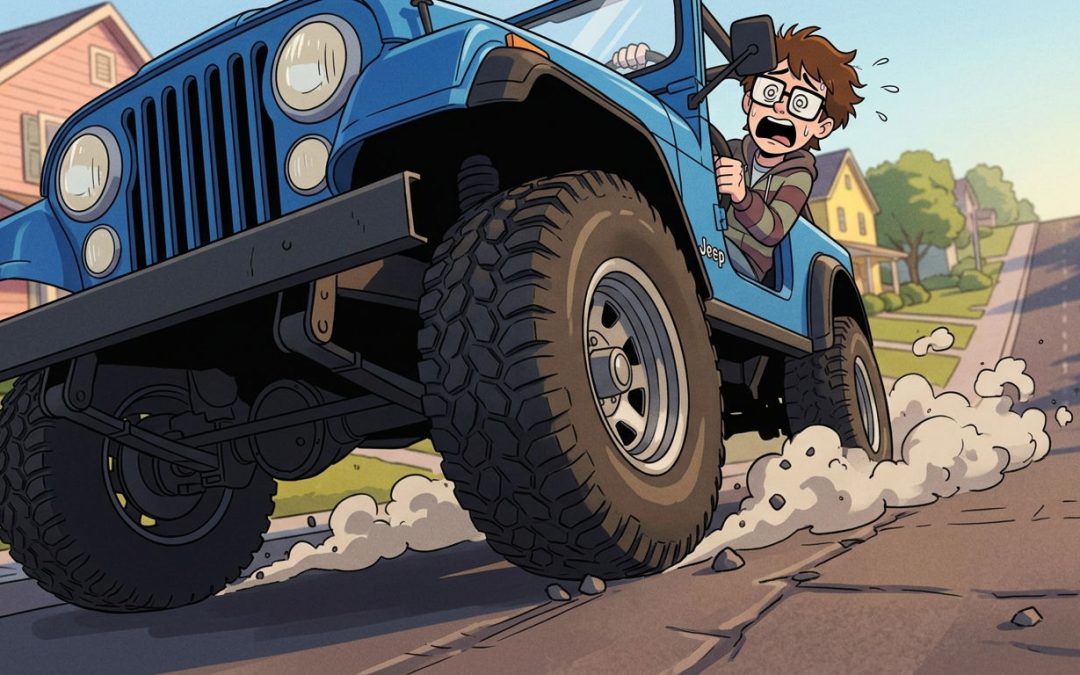
Mr. Harrison drove a Jeep CJ-7, and it was awesome. He let me drive it more times than I can count. One summer he went on vacation to Europe and left the Jeep with me the entire time he was gone. I still can’t believe that a grown man handed a teenager the keys to his Jeep for two weeks. That Jeep was easy to drive too. You could ease out the clutch on flat ground without even touching the gas and it would roll along just fine without stalling the engine. The catch was, that trick only worked on flat ground, and only if you weren’t in a hurry to go anywhere.
One afternoon after school, we headed out to the parking lot and he tossed me the keys. I fired it up and pulled up to a stop sign, ready to turn onto the main road. Only one problem. I was sitting on a hill.
If you’ve ever tried to pull away from a dead stop on a manual transmission while pointed uphill, you already know what happened next. As I moved my foot from the brake to the gas, the Jeep started rolling backward.
I panicked and slammed the brake. Mr. Harrison, calm as ever, walked me through it again, coaching me on the timing between the brake and the gas. I tried again. Rolled back again. Hit the brake again. There was a car behind me now, and the last thing I wanted was to roll into it. I tried a third time. Same result.
What happened next is the reason we’re talking about this story at all.
The car behind me belonged to our band teacher, Mrs. Throne. Instead of laying on her horn or inching up on my bumper, she backed up. Way up. Gave herself and me a good twenty or thirty feet of open pavement. Then she waved her hand out the window, gave me a smile, and settled in to wait.
I took a breath. My hands were still shaking a little on the wheel, but something about that open space behind me let the tension drain out of my shoulders. I tried again. Rolled back a little. Tried again. And then, finally, I did it. I found the balance, eased off the brake, gave it just enough gas, and pulled up that hill without stalling and without drifting backward.
Here’s what I learned.
Looking back on that day, I realize I had three different teachers helping me learn to drive a stick, and each one of them showed me something different about what it means to guide another person, especially a kid, through something hard.
My dad taught me the fundamentals. He explained the clutch, the gas, the timing. When he was patient, like that day in the quiet neighborhood, he gave me exactly what I needed and let me build confidence one small success at a time. That’s good parenting. Teach the skill. Explain the why behind it. Walk alongside instead of just barking instructions from the porch.
Mr. Harrison did something similar, but he added another layer. He gave me time. Real time, uninterrupted, low pressure. He handed me the keys to something valuable and trusted me to figure it out, even when I clearly wasn’t there yet. He coached without taking over. That’s good parenting too. Give your kids real responsibility before they’ve fully earned it, and trust them enough to let them grow into it.
But then there’s the moment with my dad in the driveway. He got frustrated because I wasn’t doing what he’d already taught me to do. And let’s be honest. This is where a lot of us live as parents. It is so easy to slide into that mindset. “Why isn’t this kid doing what I told them to do?” “If they’d just listen, they wouldn’t be stuck like this.”
I’ve said versions of that sentence to my own kids more times than I’d like to admit. It feels justified in the moment. We taught them. We showed them. So why are they still stalling out? Why can’t they just get it right?
Here’s the problem with that reaction. It confuses struggling with defiance. My dad wasn’t wrong to teach me the way he did, and he wasn’t a bad dad for getting frustrated that day. He’s human, just like the rest of us. But that moment, however well intentioned, taught me fear more than it taught me skill. I didn’t learn to drive a stick better because he took over. I just learned to be afraid of stalling in front of him.
Which brings us to Mrs. Throne, and I think she taught me the hardest lesson of the three, precisely because it looked like she did the least.
She didn’t teach me anything technical. She didn’t offer a single piece of driving advice. What she did was back up, smile, wave, and wait. She gave me space, and she stayed close enough to make sure I was safe while I used it.
That is so much harder than it sounds. Our instinct, especially as parents, is to do exactly what my dad did in the driveway. Take over. Fix it ourselves. Get frustrated when our kids don’t execute the plan we’ve already handed them. I’m guilty of it just like my dad was. It feels productive in the moment. It is almost never what our kids actually need.
What they need, more often than we want to admit, is someone to back up, give them room, smile, and trust them to work through the stall on their own. Not abandon them. Not disappear. Just create enough space that they can fail a few times without an audience breathing down their neck, and enough presence that they know someone’s still there if it really goes wrong.
That gets even harder as our kids grow up. It’s one thing to give a teenager room to figure out a hill in a Jeep. It’s a whole different challenge to give a young adult room to figure out a career, a marriage, a budget, a faith of their own. But the principle doesn’t change. Teach them what you can. Give them real time and real trust. And then, when it’s time, back the car up, give them the wave, and let them find the balance point on their own.
I don’t get back to my hometown often, but when I do, I still drive out to that hill. It’s at the corner of 6th and Asp in Wellston, Oklahoma, if you ever want to see it for yourself. These days it’s nothing. I roll up that hill without a second thought, without stalling, without a flicker of nerves. I’ve long since figured out the clutch, and I’ve climbed hills far steeper than that one in the years since.
But I have to wonder how long it would have taken me to figure that hill out, or the bigger ones that came after it, if Mrs. Throne hadn’t been willing to back up and give me the room to stall a few more times on my own.
So here’s the challenge, for me and for you. The next time someone you love is stalling out on their own hill, whatever that hill happens to be, resist the urge to jump in the driver’s seat. Teach what you can. Be patient when you can. And then, when the moment calls for it, back up, give them a smile and a wave, and trust them to find the balance on their own. You might be amazed at how far they can climb.
I’m Darrell Darnell, and this has been Stuff I Learned Yesterday.
I want you to be a part of the next Monday Mailbag on November 30th! Monday Mailbag is your opportunity to Share what YOU’VE learned, so that other listeners and I can learn from YOU. It can be a message as short as 30 seconds or several minutes long. It really doesn’t matter just as long as it’s something that will benefit others. You can send in questions or responses to my SILY episodes, and I’ll respond to them via Monday Mailbag episodes. You can participate in Monday Mailbags by visiting the Golden Spiral Media listener feedback page at goldenspirlamedia.com/feedback.