
Podcast: Play in new window | Download (Duration: 17:32 — 10.4MB) | Embed
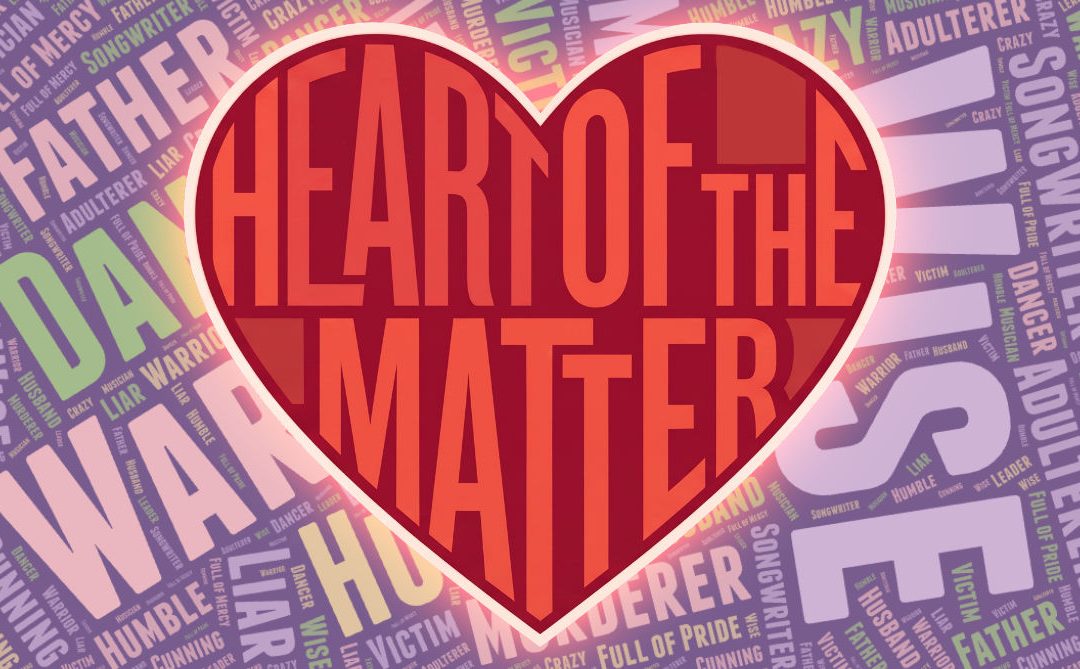
Wise. Warrior. Dancer. Husband. Father. Musician. Murderer. Songwriter. Leader. Adulterer. Victim. Full of mercy. Crazy. Cunning. Liar. Full of pride. Humble.
All of these words describe the same person. It’s a person I strive to be like, and it’s the subject of today’s story. Intrigued?
Welcome to Stuff I Learned Yesterday. This is episode 709, “Heart of the Matter.” I’m Darrell Darnell. There were 15 people who served as judges in ancient Israel, and I believe that if you aren’t learning, you aren’t living.
I’ve mentioned a few times before that when I became a Christian at 15, I started reading the Bible every day. Both testaments fascinated me, and I learned a lot in the process. One of the first things I learned was that Israel started as a theocracy. God was the leader of the nation, and He spoke through prophets and priests. I covered some of that structure back in episodes 653 and 666.
Eventually Israel entered a stretch where they were still technically a theocracy, but as the Bible puts it, everyone did what was right in their own eyes. That period was ruled by judges. Fifteen of them, one after another, trying to hold a nation together that kept looking around at its neighbors and wanting something different.
And that’s exactly what happened. Israel looked at the surrounding nations, saw they were led by kings, and decided they wanted one too. So God gave them what they asked for. The first king of Israel was a man named Saul. He was tall. He was good looking. He was exactly the kind of king people pick when they’re choosing with their eyes instead of their hearts. But he wasn’t a man of character.
After a string of decisions that revealed his pride, his disregard for God, his need to be seen, and his refusal to repent, God rejected him as king. In 1 Samuel 13 we read, “You have done a foolish thing,” Samuel said. “You have not kept the command the Lord your God gave you; if you had, he would have established your kingdom over Israel for all time. But now your kingdom will not endure; the Lord has sought out a man after his own heart and appointed him ruler of his people, because you have not kept the Lord’s command.”
So who was this new man? This man described as one after God’s own heart?
He’s the man I described in the opening. And it’s easy to see how some of those words fit him. Humble. Full of mercy. Husband. Father. Wise. Leader. Maybe even dancer, musician, songwriter, or victim. Those feel like they belong to a man after God’s own heart.
But what about the rest? Warrior. Murderer. Cunning. Adulterer. Liar. Full of pride. Those don’t feel like they belong anywhere near that description. They feel like the opposite of it.
When we first meet those words used to describe David in 1 Samuel 13, he’s just a teenager. And that’s his status when we meet him in chapter 16. He’s out tending his father’s sheep. At that stage of his life, it’s easy to see why the phrase fits. He’s a humble shepherd. The youngest in his family. Overlooked. He’s not yet a military leader or a warrior. He’s certainly not yet a murderer or an adulterer.
So maybe it’s only fair to attach that phrase, “a man after God’s own heart,” to David at that early stage of his life. Once he becomes a murderer, an adulterer, a man with blood on his hands and pride in his chest, surely that title no longer applies. Right?
Maybe.
Or maybe we need to dig deeper.
A thousand years later, this same phrase gets attached to David again. This time we find it in the New Testament, in the book of Acts, chapter 13. Verse 22 says, “After removing Saul, he made David their king. God testified concerning him: ‘I have found David son of Jesse, a man after my own heart; he will do everything I want him to do.'”
A thousand years after all of it. After the adultery. After the murder. After every failure we’re about to walk through together, the Bible is still calling David a man after God’s own heart. I love this passage in Acts because it doesn’t just tell us David earned that title. It tells us how we can earn it too.
So let’s take a closer look at David’s biggest mistakes and see what we can learn from them. 2 Samuel chapter 11 tells the story of his adultery. Starting in verse two it says, “One evening David got up from his bed and walked around on the roof of the palace. From the roof he saw a woman bathing. The woman was very beautiful, and David sent someone to find out about her. The man said, ‘She is Bathsheba, the daughter of Eliam and the wife of Uriah the Hittite.’ Then David sent messengers to get her. She came to him, and he slept with her. Then she went back home. The woman conceived and sent word to David, saying, ‘I am pregnant.'”
So how did David respond to that news? Verse 14 tells us. “In the morning David wrote a letter to Joab and sent it with Uriah. In it he wrote, ‘Put Uriah out in front where the fighting is fiercest. Then withdraw from him so he will be struck down and die.’ So while Joab had the city under siege, he put Uriah at a place where he knew the strongest defenders were. When the men of the city came out and fought against Joab, some of the men in David’s army fell; moreover, Uriah the Hittite died.”
Let that sink in. This is the same man the Bible calls after God’s own heart. He saw a woman, took her, got her pregnant while she was married to someone else, and then arranged that man’s death to cover it up. There’s no softening that. It’s ugly. It’s calculated. It’s certainly not the kind of thing we’d expect from someone associated with the phrase “after God’s own heart.”
So am I saying that to be people after God’s own heart, we need to commit adultery and murder? Of course not. But here’s an interesting thought. I’d guess most of us already have, at least by Jesus’ definition. He said, “Anyone who looks at a woman lustfully has already committed adultery with her in his heart.” He also said, “You have heard that it was said to the people long ago, ‘You shall not murder, and anyone who murders will be subject to judgment.’ But I tell you that anyone who is angry with a brother or sister will be subject to judgment.”
None of us get to stand at a safe distance from David’s failures. We just commit our versions of them in quieter, more socially acceptable ways.
To be men and women after God’s own heart, it doesn’t require sinlessness. All of us have sinned. But only David is ever given this specific title in Scripture. So what set him apart?
Acts 13 tells us again. “I have found David son of Jesse, a man after my own heart; he will do everything I want him to do.”
Here’s what I learned.
If we want to be people after God’s own heart, we don’t need clean records. We need responsive hearts. Let’s stop looking at how David sinned and start looking at how he responded to his sin.
In 2 Samuel 12, the prophet Nathan confronts David face to face about Bathsheba and Uriah. David wrote most of the Psalms, and Psalm 51 is the one he wrote right after that confrontation. It gives us a window into his heart, and it shows us what it actually looks like to be after God’s own heart.
Psalm 51 says:
1 Have mercy on me, O God, according to your unfailing love; according to your great compassion blot out my transgressions.
2 Wash away all my iniquity and cleanse me from my sin.
3 For I know my transgressions, and my sin is always before me.
4 Against you, you only, have I sinned and done what is evil in your sight; so you are right in your verdict and justified when you judge.
5 Surely I was sinful at birth, sinful from the time my mother conceived me.
6 Yet you desired faithfulness even in the womb; you taught me wisdom in that secret place.
7 Cleanse me with hyssop, and I will be clean; wash me, and I will be whiter than snow.
8 Let me hear joy and gladness; let the bones you have crushed rejoice.
9 Hide your face from my sins and blot out all my iniquity.
10 Create in me a pure heart, O God, and renew a steadfast spirit within me.
11 Do not cast me from your presence or take your Holy Spirit from me.
12 Restore to me the joy of your salvation and grant me a willing spirit, to sustain me.
13 Then I will teach transgressors your ways, so that sinners will turn back to you.
14 Deliver me from the guilt of bloodshed, O God, you who are God my Savior, and my tongue will sing of your righteousness.
15 Open my lips, Lord, and my mouth will declare your praise.
16 You do not delight in sacrifice, or I would bring it; you do not take pleasure in burnt offerings.
17 My sacrifice, O God, is a broken spirit; a broken and contrite heart you, God, will not despise.
18 May it please you to prosper Zion, to build up the walls of Jerusalem.
19 Then you will delight in the sacrifices of the righteous, in burnt offerings offered whole; then bulls will be offered on your altar.
Look at what’s happening in those first few verses. David doesn’t make a single excuse. He doesn’t say Bathsheba shouldn’t have been bathing where she could be seen. He doesn’t blame the pressures of leadership or the loneliness of being king. He takes full ownership. “I know my transgressions, and my sin is always before me.” No spin. No deflection. Just the truth, laid bare.
Verse 4 goes even further. David acknowledges that God’s standard, not culture’s, is what matters. The culture of his day might have shrugged off a king taking whatever woman he wanted. Kings did that. It was practically expected. But David doesn’t measure himself against what was normal. He measures himself against what was right.
Verses 10 through 12 show David asking, almost pleading, for forgiveness and restoration. This part matters more than we give it credit for. It’s easy to get stuck in guilt and shame after we’ve messed up. Guilt and shame serve a purpose. They tell us something is wrong. But they were never meant to be a place we live. David doesn’t set up camp in his failure. He asks God to create something new in him and to restore the joy he’d lost.
Then verses 16 and 17 remind us that we can’t buy our way back to God. Our best efforts, our sacrifices, our attempts to make up for what we’ve done, none of it settles the debt. All we can offer is a broken and contrite heart. David was looking forward to a Savior who hadn’t come yet. We get to look back at one who has. Jesus’ death and resurrection did what David’s sacrifices never could.
So a man after God’s own heart isn’t a man without sin. He’s a man who, when confronted with his sin, doesn’t run from God. He runs toward Him. He acknowledges it, he humbles himself, and he lets that failure reshape him instead of define him.
We see the same heart echoed in Micah 6:8, which asks, “And what does the Lord require of you? To act justly and to love mercy and to walk humbly with your God.” And in Mark 12:30, where Jesus says, “Love the Lord your God with all your heart and with all your soul and with all your mind and with all your strength. The second is this: ‘Love your neighbor as yourself.’ There is no commandment greater than these.”
David’s list of titles: murderer, adulterer, liar, leader, humble, wise, was never going to disqualify him from being loved by God or used by God. What mattered was what he did after each failure landed. He didn’t hide from God. He didn’t harden his heart. He came back, every time, broken and honest, and let God do the rebuilding.
Maybe you’re carrying around a list of your own right now. Some good words on it, and some you’d rather nobody ever found out about. Maybe there’s a Uriah in your past, a decision you made to protect yourself that cost someone else something they never got back. Maybe there’s a rooftop moment you wish you could undo. I’ve got my own list, and some nights it feels heavier than others.
But here’s the invitation. God isn’t looking for people with clean lists. He’s looking for people with responsive hearts. People who, when confronted, don’t defend or deflect but drop to their knees and say what David said. Create in me a pure heart. Renew a steadfast spirit within me. That prayer is available to you right now, no matter what’s on your list.
You don’t have to wait until you clean yourself up to come to Him. David didn’t earn the title “a man after God’s own heart” by avoiding sin. He earned it by refusing to stay away from God because of it. That’s the door that’s open to you and me today. Not perfection. Just a willingness to come back, again and again, with a broken and honest heart.
So today, whatever is sitting on your own list of titles, wise or warrior, humble or liar, victim or leader, I want to challenge you to do what David did. Stop managing your sin from a distance and bring it straight to God. Confess it plainly. Ask for a new heart. And then get up and live like someone who’s been forgiven, because you have been. That’s how ordinary, flawed people become men and women after God’s own heart. Not by never falling, but by always getting back up and walking straight into His arms.
I’m Darrell Darnell, and this has been Stuff I Learned Yesterday.
I want you to be a part of the next Monday Mailbag on August 31st! Monday Mailbag is your opportunity to Share what YOU’VE learned, so that other listeners and I can learn from YOU. It can be a message as short as 30 seconds or several minutes long. It really doesn’t matter just as long as it’s something that will benefit others. You can send in questions or responses to my SILY episodes, and I’ll respond to them via Monday Mailbag episodes. You can participate in Monday Mailbags by visiting the Golden Spiral Media listener feedback page at goldenspirlamedia.com/feedback.