
Podcast: Play in new window | Download (Duration: 14:07 — 8.5MB) | Embed
Have you ever been so deep into something that walking away felt impossible, even when everything inside you knew it wasn’t working? Maybe it was a job, a relationship, a project, a bad movie you sat through anyway because you’d already watched an hour and a half of it. There’s actually a name for that trap, and today’s episode is all about it.
Today we’re returning to the scene of a crime, a frustrating morning I spent fighting with my own website. That battle taught me lessons not just about building websites, but the bigger things in life, and how to know when it’s time to stop patching and just start with a clean slate.
Welcome to Stuff I Learned Yesterday, this is episode #699, “The Clean Slate.” I’m Darrell Darnell, the third episode of the TV show LOST is called “Tabula Rasa”, it has an average rating of 8.3 on IMDB, and I believe that if you aren’t learning, you aren’t living.
I’ve been building websites for almost 20 years. Mostly for my own projects. There was a stretch of three or four years where I offered it as a service, and what I discovered during that season is that building websites for other people is a completely different animal than building them for yourself. Turns out, I hate that animal. So I went back to building sites just for myself.
But a few years ago, when my main site needed a full overhaul, I made an exception. I have a good friend named Dustin who was doing web work professionally at the time, so I hired him for the job. The result was genuinely great. He came up with something I was really proud of.
Fast forward to earlier this year. Time for another overhaul. Dustin had moved on from the web game, and rather than track down someone new, I decided to roll up my sleeves and take it on myself.
Honestly? The project went pretty well. I found a template I liked, started customizing it, and while the copywriting process was tedious and took several rounds of revision, it was mostly straightforward. But I knew what was coming. Once the words were done, it would be time to wrestle with the thing I genuinely dread about web work.
CSS.
For the non-geeks in the room: CSS is the code that controls how a website looks. Font type, font size, spacing, column layout, rounded corners, drop shadows, the way the page shifts and reshapes itself depending on whether you’re on a laptop, a phone, or a tablet. CSS is what turns a wall of text into an actual website. And I hate writing it. I know just enough to get myself into serious trouble. Just enough to open a problem I don’t know how to close.
One day while I was deep in the misery of it, I was talking to Dustin and venting about how ready I was for this phase to be over. He just laughed at me. Told me he could spend an entire day writing CSS and be perfectly happy. He genuinely loves it.
He and I are not the same.
But I pushed through. I persevered. And eventually, the CSS was done, the site looked great, I sent it to a few friends for proofing, and then I launched it. What a glorious day that was.
You can probably sense where this is going.
A couple of days after launch, without me touching a single thing, the main navigation menu started displaying incorrectly. The logo and the menu, which should have been anchored on opposite sides of the header, were both just floating in the center of the page. And when you clicked the menu, it collapsed on top of the page content and became completely unreadable.
In nearly 20 years of building websites, I had never seen this happen. I’d seen CSS go haywire while I was actively working on it, sure. But for a finished, launched, working site to just randomly decide to render differently two days later? That was new.
I logged in and started digging. Checked every setting, reviewed every line of code that touched the menu. As far as I could tell, nothing was wrong. Everything looked exactly like it should.
So I did what any reasonable person does in this day and age. I brought in an AI tool.
I gave it the details about my site and the code I had in place, and asked it to help me figure out what was going wrong. It came back with a list of settings to check. I checked them all. Everything looked fine.
So we moved on to the CSS itself. The AI gave me a new piece of code to try. I dropped it in. It worked! Sort of. The logo snapped back into place, but the menu was still off. So it gave me another piece of code. That fixed the menu, but now something else was broken. Another piece of code. That thing was fixed, but now a new thing was wrong.
We were playing whack-a-mole. And I kept swinging.
By the time I finally stopped and took a breath, I had been at this for over an hour. What I had hoped would be a five-minute fix had eaten my morning and left me more frustrated than when I started. The code was now a tangled mess of patches layered on top of patches, and I was no closer to a solution than I’d been at minute one.
And then I had a moment of clarity.
I stopped and asked the AI to step back. To look at the full picture of everything we’d tried, everything we’d added, and start over. Forget the patched code. Forget the hour of whack-a-mole. Give me a clean slate.
A moment later, it gave me a short, simple piece of code and told me to replace everything we’d been adding with just that.
I did.
It worked. Completely. Everything was fixed. No new problems, no complicated layers of workarounds. Clean and simple, and the site looked exactly like it was supposed to.
Here’s what I learned.
What I experienced that morning has a name. Economists and psychologists call it the sunk cost fallacy. And once you see it, you’ll start finding it everywhere.
Here’s the basic idea: a sunk cost is any investment of time, money, energy, or emotion that you’ve already spent and cannot get back. It’s gone. The sunk cost fallacy is what happens when we let that unrecoverable investment drive our future decisions. When we keep going not because continuing makes sense, but because we’ve already put so much in that stopping feels like losing.
The logic sounds reasonable on the surface. “I’ve already spent an hour on this, so I might as well keep going.” But think about that for a second. The hour is already gone whether you stop or not. The only question that actually matters is: what’s the best move from here?
We don’t naturally think that way. And that’s where we get into trouble.
You’ve probably lived a version of this yourself. You’re 200 pages into a book and it’s just not doing it for you, but you keep reading anyway because you’re 200 pages in. Or you’re an hour and a half into a movie and you can tell it’s going nowhere, but you sit through the bad ending because you’ve already given it an hour and a half. The time is gone either way. The only thing you’re deciding now is whether to spend more time on something that isn’t working.
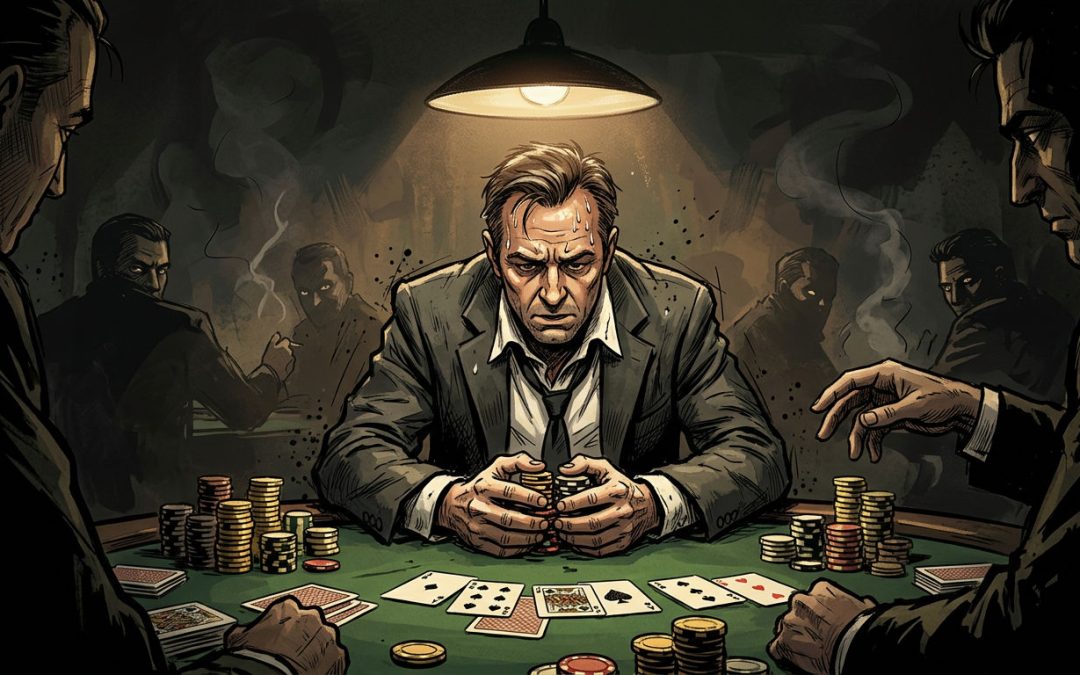
In the world of poker, they have a specific name for a version of this. It’s called being pot committed. That’s when you’ve put so many chips into a hand that folding feels psychologically impossible, even when the smart play is to cut your losses and wait for a better hand. The problem is, the chips already in the pot are gone. They’re not yours to win back by staying in. You can only decide what to do with the chips you still have. But the emotional weight of what’s already in the middle of the table clouds that judgment. It traps you.
That’s what I was doing with my website. Every piece of code I added to fix the last problem became another chip in the pot. And instead of stepping back and folding, I kept playing the hand. Adding more, complicating more, digging the hole deeper.
The cleanup took about 30 seconds once I was willing to start fresh.
The sunk cost fallacy shows up in some of the most significant decisions of our lives. People stay in jobs they’ve outgrown for years past the expiration date because they’ve put in so much time and worked so hard to get to where they are. People stay in relationships that have quietly stopped working because of everything they’ve invested, every memory, every year, every version of themselves they gave to that person. Entrepreneurs pour more and more money into business ideas that the market has clearly rejected because they’ve already poured so much in. Investors hold on to losing positions long past the point of reason because selling feels like admitting a mistake.
And I want to be careful here, because not every hard thing is a sunk cost trap. There’s real wisdom in perseverance. There’s genuine value in pushing through difficult seasons rather than bailing at the first sign of resistance. The question isn’t whether something is hard. The question is whether you’re continuing because it’s genuinely the right path forward, or whether you’re continuing because leaving would mean admitting that the past investment was a loss.
That’s the key distinction. And it’s not always easy to see clearly, especially when you’re in the middle of it.
So how do you tell the difference?
Start by asking yourself this: If I hadn’t already invested what I’ve invested, would I choose to start this today? If the honest answer is no, that’s a signal worth sitting with. Not a final verdict, but a signal.
Ask yourself what the cost of continuing actually looks like. Not just financially, but in terms of time, energy, mental health, and opportunity. Every hour you spend on the thing that isn’t working is an hour you’re not spending on the thing that might. Every dollar poured into a failing venture is a dollar that can’t go somewhere with better prospects. Continuing has a cost. We just tend to forget to count it.
Pay attention to the emotional weight you feel around the decision. The sunk cost trap is heavily emotional. It hides behind words like quitting and giving up, as if stopping is a character flaw rather than a strategic choice. We’re wired to avoid the feeling of loss more than we’re wired to pursue gain. Psychologists call this loss aversion, and it’s one of the core reasons the sunk cost fallacy is so sticky. Letting go genuinely feels like losing, even when it’s actually freeing you.
And finally, ask yourself if there’s a cleaner path that you’ve been avoiding because it would require admitting the current path isn’t working. Sometimes the clean slate isn’t just an option. It’s the obvious answer that we’ve been talking ourselves out of because our pride or our grief or our fear won’t let us see it clearly.
I spent an hour patching broken code that morning. And in the end, the thing that actually fixed the problem was the thing I could have done at the five-minute mark: step back, let go of everything I’d built up, and start with something simple and clean.
The lesson wasn’t really about CSS. It was about what we hold onto, and why, and what it costs us to keep holding on when the smarter move is to open our hands.
Sometimes the bravest thing you can do isn’t push through.
Sometimes it’s fold, take a breath, and play the next hand better.
Take a look at whatever you’ve been adding patches to lately. Whatever project, relationship, job, investment, or decision where you keep layering fix on top of fix and wondering why it still isn’t working. Ask yourself honestly: am I continuing because this is worth continuing, or am I continuing because I’ve already come this far?
And if the answer is the latter, give yourself permission to clear the slate.
You might be surprised how simple the solution looks from a clean start.
I’m Darrell Darnell, and this has been Stuff I Learned Yesterday.
I want you to be a part of the next Monday Mailbag coming up on June 29th! Monday Mailbag is your opportunity to Share what YOU’VE learned, so that other listeners and I can learn from YOU. It can be a message as short as 30 seconds or several minutes long. It really doesn’t matter just as long as it’s something that will benefit others. You can send in questions or responses to my SILY episodes, and I’ll respond to them via Monday Mailbag episodes. You can participate in Monday Mailbags by visiting the Golden Spiral Media listener feedback page.