
Podcast: Play in new window | Download (Duration: 12:36 — 7.6MB) | Embed
When he was only 16 years old, C.S. Lewis had his first vision of what would become the land of Narnia. Just a mental image. A faun carrying an umbrella and parcels in a snowy wood. That’s it. That’s all he had.
I’ve thought about that a lot. There’s something that just fascinates me about the journey from that single image in the mind of a teenager to the deep, layered, inspiring world that millions of people have come to love. A world that exists on the other side of a wardrobe. A world that took years of imagination, discipline, and patience to build.
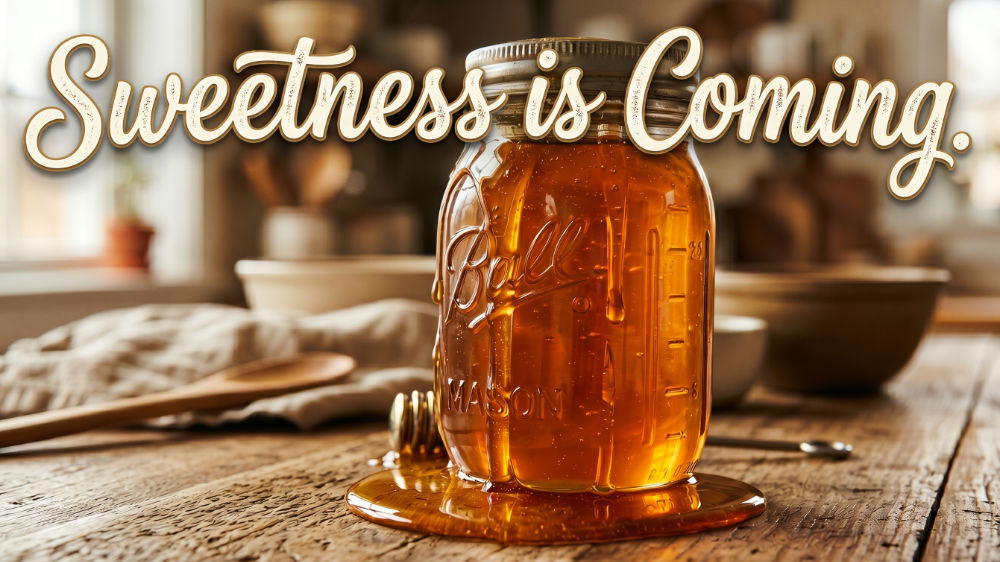
I recently had a dream about a mason jar full of honey. And when I woke up, I had to immediately write it down. We won’t be visiting anything like Narnia today. There are no fauns, no packages, no lions, no witches. But I do hope this leaves you inspired in its own way.
Welcome to Stuff I Learned Yesterday. This is episode 695, “Sweetness is Coming.” I’m Darrell Darnell, the C.S. in C.S. Lewis stands for Clive Staples, and I believe that if you aren’t learning, you aren’t living.
And you superfans of the show LOST might remember that season four brought us a character named Charlotte Staples Lewis, one of the many characters from that show inspired by literature.
Now, that dream was unusual for a few reasons.
It was one of the few dreams I actually remembered vividly after waking up. And it included a friend of mine named Mark. Mark is also a listener of this podcast, so hi, Mark!
The dream itself was short and simple, but vivid. In it, Mark was drinking honey straight from a mason jar. Which was unusual on a couple of levels. One, it was just a weird dream. Two, Mark lives in the province of Ontario, Canada, and honestly, I wasn’t even sure if they had mason jars up there, or if that was purely an American thing.
So I reached out to him. I asked if he even knew what a mason jar was. His reply? He just sent me a picture of himself holding one. I told him I thought it was hilarious that he owned one, given my doubts, and then I told him about the dream. That I had seen him drinking honey from a mason jar.
He told me he’d drunk a lot of things from a mason jar. But never honey.
However, he also mentioned that they had recently cracked the plastic lid on their honey container and were currently storing their honey in a mason jar.
Weird, right?
While that conversation with Mark was fun and honestly a little spooky, it didn’t fully satisfy what I felt like the dream was nudging me toward. I felt like there was something I needed to sit with, something I needed to think about.
And so I did. Like a bee going from flower to flower, I let my mind wander through the world of honey. How much people love it, how satisfying it is, what the Bible has to say about it, how it’s been used for medicinal purposes for thousands of years.
And then I started thinking about where it actually comes from. About the process. About those amazing, remarkable, endlessly industrious little bees. Honey is one of the most inspiring foods on the planet.
It starts with the forager bees, the worker bees whose job is to leave the hive and go find nectar. These bees visit somewhere between 50 and 100 flowers on a single trip. One trip. And they’re doing this over and over and over again. They use a straw-like mouthpart called a proboscis to suck up nectar from flowers, and they store it in a special second stomach, literally called a honey stomach, that they use just for transporting nectar back to the hive.
When they get back, they pass that nectar to a group called the receiver bees, who chew it and add enzymes to it. This enzymatic process begins breaking down the complex sugars in the nectar into more simple sugars, which is what eventually gives honey its long shelf life and those incredible health properties. The receiver bees then deposit the processed nectar into the hexagonal wax cells of the honeycomb.
And then patience and more hard work kick in. That nectar is still about 70 to 80 percent water at this point. Honey needs to be closer to 17 to 20 percent water. So what do the bees do? They fan it. Thousands of bees beat their wings, over 11,000 times per minute by the way, over the open cells of honeycomb to evaporate the water out of the nectar.
They literally air-dry it with their wings. Day after day. Fanning, fanning, fanning. Once the moisture level drops low enough, they seal each cell with a wax cap to preserve it. That sealed cell is finished honey.
The entire process from nectar to capped honey takes roughly 45 days.
Okay, ready to get your mind blown? To produce just one pound of honey, bees collectively visit over two million flowers and fly approximately 55,000 miles. Two million flowers. 55,000 miles. For one pound of honey. And a single worker bee, across her entire lifetime, will produce about one-twelfth of a teaspoon of honey. That’s it. That’s her whole life’s work in honey.
I’ll give you a moment with that.
Once the beekeeper decides the honey is ready to harvest, the work is far from over. The frames are carefully removed from the hive, and the wax caps are cut away with a knife. The uncapped frames are then placed into a centrifuge that spins them at high speed, pulling the honey out and sending it cascading down the walls of the extractor into a collection tank below.
From there, the honey is filtered to remove any remaining wax, debris, or bee parts. Depending on how processed the final product will be, it may be filtered once or several times. Then it settles. Then it’s tested for moisture content and quality. Then it’s heated just enough to slow crystallization so it flows properly.
Then it’s bottled. Then it’s labeled. Then it’s loaded onto a truck. Then it travels to a distribution center. Then it travels again to a store. Then it sits on a shelf. And then you pick it up, bring it home, and drizzle it on your biscuit (or pour it into your favorite mason jar) without a second thought. All of that work for that one moment.
Here’s what I learned.
We live in a world that is addicted to fast. Fast food. Fast shipping. Fast results. Fast everything. We want what we want, and we want it now, and if it takes longer than a few days we start to wonder if something is wrong.
But the best things, and I mean the really good things, they almost never come fast.
Honey doesn’t come fast. Honey comes from millions of tiny, faithful acts of effort by creatures that don’t quit, don’t complain, and don’t demand to see the finished product before they start working. The bees don’t know what the honey is going to look like when it’s done. They don’t stand at the entrance of the hive and wait until conditions are perfect before they start flying. They just go. Flower by flower. Day by day. Wing-beat by wing-beat. They trust the process, even without being able to see the end of it.
And what they produce is remarkable. Not just tasty, but medicinal. Timeless. Ancient Egyptian honey found sealed in tombs was still edible thousands of years later. Properly capped honey essentially never expires. The reward for all of that patient, persistent, invisible work is something with extraordinary staying power.
I think about the things in my own life that have taken a long time to become what they were meant to be. Relationships that had to weather hard seasons before they deepened into something real. Skills I had to practice for years before anyone noticed I had them. Character that could only be built slowly, through failure and reflection and trying again.
None of that happened overnight. None of it came from rushing. All of it required me to keep showing up, keep working, keep fanning those wings even when I couldn’t see the honey forming yet.
And I think about the things I’ve walked away from too soon because the results didn’t come fast enough. The habits I dropped after three weeks. The goals I abandoned after a few setbacks. The investments of time, of energy, of relationships that I made and then gave up on because I was impatient.
The bees don’t do that. They’re in it. All the way in it. And the world is genuinely better because of them.
There’s a line in Proverbs that says, “Pleasant words are a honeycomb, sweet to the soul and healing to the bones.” The Bible uses honey as a metaphor for the best things: wisdom, kindness, words that build people up. And I don’t think that’s an accident. The writers of scripture understood something that we tend to forget. Sweetness has a cost. Real sweetness takes work, takes time, takes trust in a process you can’t fully see.
Think about that long journey C.S. Lewis took. From that single image of a faun in the snow at age 16, it was another 36 years before “The Lion, the Witch and the Wardrobe” was published in 1950. Thirty-six years. And that image that started as a fleeting thought in a teenager’s mind eventually became a world that has shaped generations. Because he didn’t rush it. He let it develop. He did the work. He trusted the process, even when the end result wasn’t visible yet.
Your life is like that. The things you’re building right now, your family, your career, your character, your faith, your relationships, they are in the hive. They are being made. The water is being fanned out. The cells are being filled. And just because you can’t see the finished product yet doesn’t mean the work is going anywhere.
Don’t leave the hive too soon.
Here’s the challenge I want to leave you with today. Think about one thing in your life that you’ve been impatient about. One process you’ve been tempted to quit, or rush, or shortcut. Maybe it’s a goal you’ve had for years that still feels far away. Maybe it’s a relationship that’s been slow to heal. Maybe it’s a dream you’ve been carrying since you were young that doesn’t have a clear timeline yet.
Whatever it is, I want you to treat it like a hive today. Go back to it. Do the small, quiet, consistent work. Fan the wings. Visit the flowers. Trust that what you’re building has value, even in the stages where it doesn’t look like anything yet.
The sweetness is coming.
I’m Darrell Darnell, and this has been Stuff I Learned Yesterday.
I want you to be a part of the next Monday Mailbag on June 29th! Monday Mailbag is your opportunity to Share what YOU’VE learned, so that other listeners and I can learn from YOU. It can be a message as short as 30 seconds or several minutes long. It really doesn’t matter just as long as it’s something that will benefit others. You can send in questions or responses to my SILY episodes, and I’ll respond to them via Monday Mailbag episodes. You can participate in Monday Mailbags by visiting the Golden Spiral Media listener feedback page.