
Podcast: Play in new window | Download (Duration: 19:35 — 11.6MB) | Embed
I recently finished watching the final season of Stranger Things. Without spoiling anything for those of you who haven’t seen it yet, there’s a profound conversation near the end of the season. One character is struggling with the weight of a painful loss and the guilt that comes with it. Another character, who’s been down a similar road, offers some wisdom about the choice we all face when dealing with difficult relationships and painful circumstances. The moment I heard the conversation tears began rolling down my face. It absolutely wrecked me and taught me something powerful.
Welcome to Stuff I Learned Yesterday. This is episode 688, “Two Roads.” I’m Darrell Darnell, earlier this year my daughter and I were interviewed by BBC radio about the series finale of Stranger Things, and I believe that if you aren’t learning, you aren’t living.
That was a really cool and fun moment for us.
Again, without including spoilers, the conversation from Stranger Things goes like this:
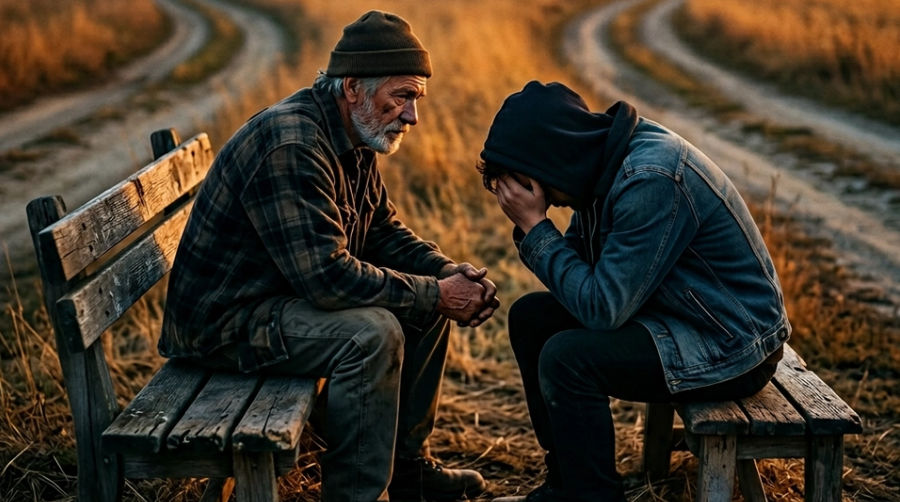
It’s not your fault. What happened is not your fault. She made her choice. Now it’s time for you to make yours. And the way I see it, you got two roads ahead of you. You got one road where you keep blaming yourself for what happened. You keep going over it in your head, what you could’ve done differently. You push people away, and you suffer, because that’s what you think you deserve.
And then there’s another road… where you find a way to accept what happened. Find a way to accept her choice. Doesn’t mean you gotta like it. Doesn’t mean you gotta understand it and never think about it. You just accept it. And you live the best life you can. I’ve been down that first road before. And I don’t recommend it.
When I heard this conversation, I couldn’t stop thinking about it. It perfectly captured something I’ve lived through myself. Back in January on The Stranger Things Podcast, I shared a brief version of my own story about a difficult relationship. The response was overwhelming. So many listeners reached out to thank me for sharing and to tell me how it helped them process their own difficult relationships.
That’s why I wanted to devote an entire episode to this today.
That personal relationship is the one I have with my mom. I last mentioned the difficulties of this relationship all the way back in episode 7 of this podcast. Today I’m sharing an update with the hope that it will help at least one of you who are struggling with a difficult relationship too.
Since I don’t expect any of you to remember the details of an episode from twelve years ago, let me give a quick recap, and then I’ll share what has happened since I first shared this story.
I was nine years old when my parents sat my brother and me down and told us they were getting divorced. My brother was eleven.
My mom felt it was important for us to have the daily influence of a father, so dad got custody of both of us. I’m grateful she made this decision. Whether it was selfishly motivated or not, I can’t say, but I do agree that it was in our best interest to be raised by our dad. We saw her on weekends and during summers. Dad remarried later that year. Mom dated a couple of guys.
Then, about two or three years after the divorce, mom moved to California to be closer to a guy she was dating. I was twelve years old. That was the last time I saw her in person. I’m fifty now.
At first, we talked regularly. Birthdays, Christmas, and several times in between. Then it became birthdays and Christmas and a few times in between. Then just birthdays and Christmas. Then hardly at all. The fade happened slowly, over years.
She often said she was coming to visit. There was always a plan. A dog show in Texas where she’d drive through Oklahoma to see us. A plan to sell some things and use the money for a trip. Something always fell through and she never came. I convinced myself she wanted to come but just didn’t have the money. Good intentions, bad circumstances. I gave her the benefit of the doubt.
Her relationship with her boyfriend eventually ended and a few years later she married a guy named Tom. By this time I was managing a bookstore in Wichita Falls, Texas. Tom’s kids lived in Tennessee, and one day mom told me they’d found someone to oversee the mobile home park they managed so they could take a trip to see his kids. On their way to Tennessee, they’d come through Oklahoma City.
Perfect. My brother was stationed at Fort Sill at the time, about thirty minutes north of me and an hour and a half from Oklahoma City. I was only two hours away myself. They’d be taking I-40 right through the city. It would be easy to arrange a meetup.
Then, shortly before the trip, she called. The guy that was supposed to oversee the park had become untrustworthy. They were canceling. I was disappointed but understood. Again I gave her the benefit of the doubt.
We eventually moved back to Oklahoma City. Shortly after one of our kids was born, Mom called to congratulate us. During the conversation she mentioned something about a recent experience in Tennessee. I brushed it off. Told myself I’d misunderstood.
A month later we spoke again. She mentioned Tennessee again. This time there was no mistaking it.
She and Tom had traveled to Tennessee to see his kids. They’d driven right through Oklahoma and kept right on driving.
A year or so later they moved to Tennessee. I didn’t even know they were heading east until after they’d already moved. Once again, they drove straight through Oklahoma and never let us know they were here.
That’s when the painful truth finally settled in. My mom did not want to see me.
All those promises over the years had been empty. I wanted to give her the benefit of the doubt. I wanted to create excuses for her. Excuses like: it would be too hard, too awkward. But I was done playing games. If she truly wanted a meaningful relationship with me, she’d need to reach out, be honest, and make the first move.
Perhaps that sounds harsh to you, or perhaps you think I should have realized it a long time before I did. Maybe I should have. That doesn’t matter. What matters was what I did once I finally realized the truth. I had a choice. Would I continue letting her treat me this way and be disappointed by broken promises, or would I just move on?
I chose to move on. I didn’t need her in my life.
To clarify, I didn’t need her in my life in order to be happy, complete, satisfied, or fulfilled. Instead of putting energy into a relationship that negatively impacted me and my family, I chose to invest only in relationships that were healthy. I have never regretted that decision.
And that’s the way it was for a long time. Eventually we connected on Facebook and my brother connected with her as well. We didn’t really talk much but it gave us a peek into each other’s lives…sort of. For reasons I’m not sure of, Facebook rarely shows me stuff from her. But I guess it shows her stuff from me because I see her liking and commenting from time to time.
And that was nice. I liked that she was enjoying photos of our kids and seeing what was happening with our family. We’d send each other occasional messages: birthdays, Mother’s Day, Christmas, stuff like that. She’s friends with both of my kids on Facebook as well, which is nice. Although their generation rarely uses Facebook, so there’s that.
Last year she started commenting more. She started listening to this podcast. I’m not sure if she listened to all the episodes, but I know she at least listened to some of them. In mid-December she messaged me and let me know she’d just checked out episode 675 and wondered if I had any memories of when we were a family.
I took a few days to think about her question and how I would respond. I replied and told her that although they divorced when I was 9, I did have some memories from the home we lived in when I was 4 until I was 7 and the home we lived in from when I was 7 until they divorced. I shared a memory I had of when her parents came to visit us. I also told her I had a few memories of when we would visit her after the divorce.
She replied that she was glad that I had some memories of us and that she hoped some of those memories were good ones. I gave her a smiley emoji and told her that I did have some good memories of those days.
While brief, it was the most personal conversation we’d had in over 20 years. Less than two weeks later she messaged me again. She said, “I have been praying about the fact that you don’t really remember me. I think it might be best if I leave it at that. You don’t remember me and your family don’t know me so it might be better if I leave it that way.”
I was totally shocked to hear this. We’d just had the most meaningful conversation we’d had in years. I thought it was a positive interaction, something that might be the beginning of us having some sort of meaningful relationship.
I was confused and I needed help.
I’d forgiven my mom years ago. I didn’t hold any anger or animosity toward her. I truly wanted her to be happy and enjoy life with those closest to her. And I’d made peace with the fact that didn’t include me. Those things are still true, but this latest message hit me in a way that I didn’t expect. I was taken back by it.
As I always do, I confided in my wife. But for the first time in my life, I also sought counseling. That conversation with the counselor was difficult. I told the counselor the story I’ve just told you, including the last message my mom sent to me.
The counselor told me that her message sounds less like “I don’t want you in my life” and more like she’s giving herself permission to walk away from guilt she can’t face, but she seems to be framing this as though she’s doing me a favor.
We talked about the different feelings my mom might be feeling and we talked about how this most recent message hit me differently because it caused old emotions to resurface. We talked about anger, relief, grief, and confusion, but none of those seemed to be my issue.
And then we talked about old childhood wounds reopening and I was suddenly sobbing uncontrollably. What my counselor told me revealed pain that I didn’t know existed until it was spoken. And the advice they gave me was so healing and powerful. I want to share it here in hopes that it might help at least one of you.
My counselor said, “Your mother has spent 37 years avoiding the hard work of repair. Now she’s offering you an out that lets her avoid it forever. You get to decide if you want to accept that, challenge it, or simply witness it and walk away. Whatever you choose, please know: You were always worth the visit. You were always worth the effort. Her inability to see that is her tragedy, not your failure.”
My counselor also encouraged me to take my time. They said, “You don’t have to respond immediately. And whatever you decide, make sure it honors the 12-year-old boy who kept believing she’d come, and the 49-year-old man who deserves better.”
I am grateful that I’ve never once felt guilty for my parents divorce, her choosing to move away, or her decision to not visit. Somehow I always understood those things weren’t my fault. I know that some of you have struggled with those things and I hope you can come to a place of peace where you realize you’re not to blame and you shouldn’t feel guilty.
So how did I respond?
My counselor and I talked about four different ways I could go. In the end, I chose to blend two options together. I wanted to lovingly and honestly call out her deflection. But I also wanted to leave the door open for reconciliation while setting boundaries.
With the help of my counselor, I crafted this reply: “Mom, I think there’s a misunderstanding here. I DO remember you—that’s not the issue. What I don’t have is a relationship with you that was built over the last 37 years. My children don’t know you, not because they can’t remember you, but because you haven’t been present in our lives.
I spent a lot of my childhood and young adulthood believing your promises to visit and giving you the benefit of the doubt when they didn’t happen. When you and Tom drove through Oklahoma on your way to Tennessee without stopping—without even telling me—I realized the broken promises weren’t about circumstances beyond your control, but were intentional. That was a turning point for me.
I understand this might be painful for you to face, and I can see you’re struggling with guilt. But if you’re going to step back, please don’t frame it as though you’re doing it for my benefit or because I don’t remember you. That’s not what’s happening here.
If you want to leave my life, that’s your choice and I’ll respect it. But if you ever want to actually build a real relationship—one that requires genuine effort, presence, and follow-through—I’m willing to consider that. The door isn’t locked, but you’d have to be the one to walk through it.”
This was hard for me to write. To realize she was once again backing out of my life and framing it as if she was doing me a favor was difficult for me to deal with.
Here’s what I learned.
That conversation from Stranger Things is right. When you’re dealing with a difficult relationship or a painful loss, you’ve got two roads ahead of you. One road is blame, isolation, and suffering. The other road is acceptance, boundaries, and living the best life you can.
I forgave my mom years ago. Not because she asked for it. Not because she acknowledged what happened or apologized. I forgave her because holding onto anger would only poison my own life. Forgiveness is something you do for yourself as much as for the other person. Maybe more.
If you’re carrying around hurt from someone who hasn’t asked for forgiveness, I want you to hear this. You don’t need their permission to forgive them. You don’t need them to admit what they did. You don’t need closure from them to find peace. Forgive them anyway. Let it go. Not for them, but for you.
At the same time, be brave enough to protect yourself. Forgiveness doesn’t mean you have to keep letting someone hurt you. It doesn’t mean you can’t set boundaries or walk away from a relationship that’s damaging you. Love and boundaries can exist in the same space. In fact, sometimes boundaries are the most loving thing you can do, both for yourself and for the other person.
And here’s something else. Be honest, even when it’s hard. Especially when it’s hard. When my mom sent that message framing her exit as a favor to me, I could have let it slide. I could have said nothing and just let her go quietly. But that wouldn’t have been honest. It wouldn’t have honored the truth of what happened. So I spoke up. I called it what it was. Not to hurt her, but because real relationships, even difficult ones, deserve honesty.
If you want reconciliation with someone, seek it. Be brave enough to reach out, to have the hard conversation, to do the difficult work of repair. But also be wise enough to know that reconciliation takes two people. You can offer it. You can leave the door open. But you can’t force someone to walk through it.
And please, if you’re struggling with something like this, don’t be afraid to seek help. For years I thought I’d dealt with this. I thought I’d moved on. And in a lot of ways, I had. But when that message from my mom hit me differently than I expected, I knew I needed someone to help me process it.
There’s still such a stigma around counseling. People think it means you’re broken or weak or can’t handle your own problems. That’s garbage. Seeking counseling is one of the bravest, smartest things you can do. It means you’re self-aware enough to know you need help, humble enough to ask for it, and strong enough to do the hard work of healing.
That one conversation with my counselor helped me see things I couldn’t see on my own. It gave me language for pain I didn’t even know I was carrying. It helped me craft a response that was both honest and compassionate. I’m so grateful I had the courage to seek help.
If you’re on the fence about counseling, please don’t wait. Find someone. Talk to them. Let them help you carry what you’re carrying. You don’t have to do this alone.
You’ve got two roads ahead of you. One leads to blame and suffering. The other leads to acceptance and the best life you can live. That first road is brutal and self-destructive, and I don’t recommend it.
Mom, if you’re listening to this, I want you to know something. I love you. I want you to be happy. I want you to have peace with those closest to you. I hold no anger toward you. I’ve forgiven you. I mean that sincerely
The door is still open if you ever want to walk through it. But if you don’t, I understand. I’ll be okay either way. I just want you to know that whatever you decide, I wish you the best, always.
I’m Darrell Darnell, and this has been Stuff I Learned Yesterday.
I want you to be a part of the next Monday Mailbag coming up in three weeks on March 30th! The submission deadline is Wednesday, March 25th. Monday Mailbag is your opportunity to Share what YOU’VE learned, so that other listeners and I can learn from YOU. It can be a message as short as 30 seconds or several minutes long. It really doesn’t matter just as long as it’s something that will benefit others. You can send in questions or responses to my SILY episodes, and I’ll respond to them via Monday Mailbag episodes. You can participate in Monday Mailbags by visiting the Golden Spiral Media listener feedback page at goldenspirlamedia.com/feedback.