
Podcast: Play in new window | Download (Duration: 11:57 — 7.2MB) | Embed
Welcome to Stuff I Learned Yesterday. My name is Darrell Darnell. The first internet-capable cell phone was the Nokia 9000 Communicator released in 1996. And I believe that if you aren’t learning, you aren’t living.
I don’t know about you, but I was shocked to learn the first internet-capable phone was released in 1996. The internet wasn’t even a mainstream thing yet in 1996, so to think it was available on a phone blows my mind.
I’ve always loved technology and computers, but I resisted getting a cell phone for several years. Growing up in the 80’s and 90’s, only rich people had cell phones and very rich people had car phones. I don’t think I knew a single person who owned either.
Microprocessors and related technology became more advanced at breakneck speed throughout the 90’s and the first decade of the new millennium. According to Pew Research, over 60% of US adults owned a cell phone by the year 2002. By 2010 that number was up to 80%. That decade saw the rise of BlackBerry smartphones due to their small size, tactile keyboard, and ability to handle email.
Of course, everything changed after Apple released the first iPhone in 2007. By that time nearly all of my colleagues and personal friends had some sort of cell phone, but I still resisted. It wasn’t until we launched the e-commerce site at the bookstore that I finally got a cell phone. I needed an internet capable phone that I could use to login to the back end for troubleshooting and emergencies, so I purchased an HTC Tilt.
I knew that once I purchased a cell phone that I was attaching myself to a digital leash, and I wanted no part of that. Perhaps it was because I was a kid of the 80’s. In those days we could take our bikes and go anywhere we wanted, do anything we wanted. Our parents didn’t care as long as we were home by sundown. That freedom was special. In some way, I wanted to keep that.
My kids were born in 2002 and 2004, so they were never in front of a screen as toddlers. By the time the first iPad came out in 2010, they were nearly 6 and 8 years old. As I look back on it now, I’m grateful that my kids were young enough that these devices didn’t enter into their lives at those very young ages.
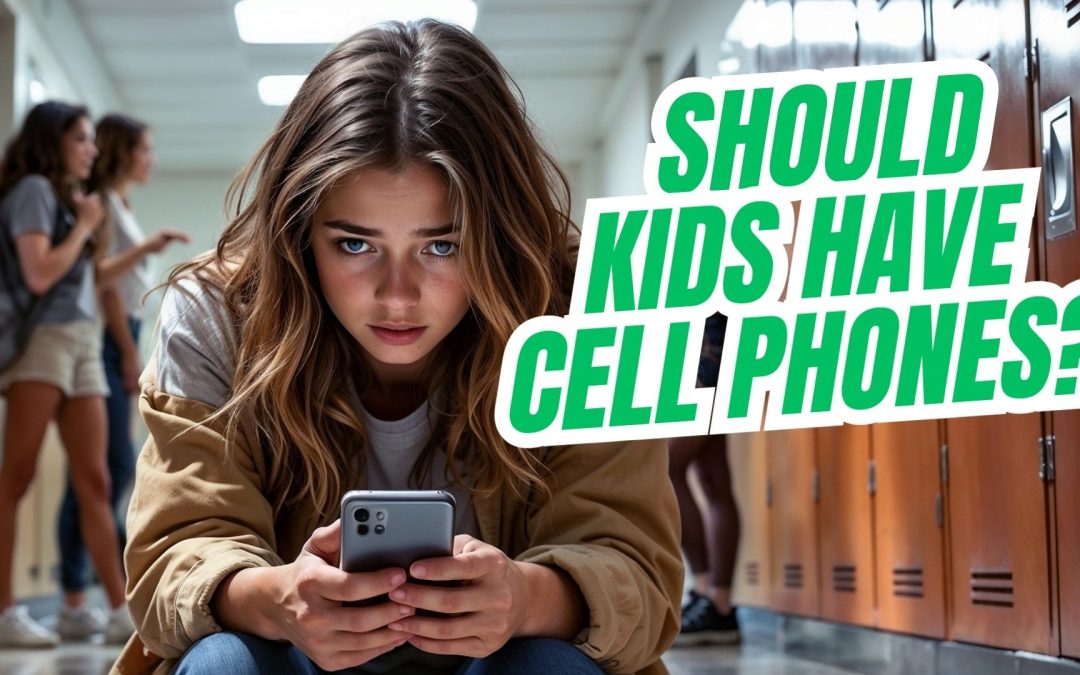
But eventually their lives did intersect with this technology and it became an issue, a struggle, a battle. For parents today, that battle starts at an even earlier age. It’s a tough battle to traverse, a minefield of dangers with a few benefits sprinkled in. Do those benefits make navigating the dangers worth it? If so, at what age are those battles worth waging?
Every household is different. Every child is different. So these decisions, which should be taken seriously, are very much an individual decision. For us, by the time cell phones came into the fray of consideration, both Kari and I were working from home and we lived just over a mile away from the kid’s middle school. The maturity level of our kids differed. Our youngest was the more mature, which was a factor we considered.
Middle school is an incredibly difficult time for nearly every child, and our children were no exception. Both kids were on the receiving end of bullying and mocking. To some extent we expected this. Our school district has some very wealthy families in it. When I was in high school I dated a girl that attended the high school my kids would eventually attend.
Even in the 90’s the culture was toxic. For example, the girl I dated was mocked because she drove a car with four doors. The other kids at school teased her for driving a “mom car.” Meanwhile at my school, I drove my step-mom’s minivan for about a month and the kids at my school loved it because it meant more of us could pile in and hang out after school.
So as our kids aged, I was prepared for them to get mocked about stupid things like our simple lifestyle. Or at least I thought I was. Addi was mocked for not having a phone. Mind you, it wasn’t enough to have a phone and it wasn’t enough to have an iPhone. She needed to have one of the newest models of the phone. Otherwise, the other girls made fun of her.
Addi had always struggled to make friends, often trying too hard and making things worse. It was such a hard time for her. But we were staunch in our belief that she did not need nor would benefit from a cell phone. Addi would tell us that she was required to have a phone in order to interact with classroom activities and assignments, but her teachers were telling us that phones were not required for those things.
Eventually we decided to give her an old phone which didn’t have cell service, but she could use to connect to the school’s wifi for classroom and assignment purposes. Of course, she was mocked for this and was not happy with our decision to not give her a “real phone.”
I don’t recall how long this persisted, but eventually we did get her a real phone. In our district, middle school is 6th, 7th, and 8th grade, so if I had to guess, it was 7th grade when we got her the real phone. By that time she was choosing to walk home from school and would often spend time at friends’ houses, so the phone gave us peace of mind in those situations.
With both our kids, once they got a phone, we locked it down with parental controls that restricted which apps they were able to install and which websites they were allowed to visit. We also let them know that we were able to take their phone and look at their messages at any time and they had to follow certain guidelines in order to keep the privilege of having a phone.
Here’s what I learned.
Ten years have now passed since we navigated that minefield. So how did we do?
Mostly, I think we made the right decisions. Personally, I still think we allowed Addi to get a phone too soon. We went through some drama where one of her friends texted Kari and told us that Addi had a second phone that she kept secret from us. We asked her about it then and a few times in more recent years, and she insists she has no idea what that friend was talking about.
But more importantly, the drama was related to girls being mean to her if she didn’t have a phone or the “right” phone, or with messaging that we found on her phone. With the messaging, it allowed us an opportunity to sit down with her and talk about what was wrong with her language and other things she was talking about.
To her credit, she grew from those conversations and I’m grateful the phone allowed us to have those conversations. As for the drama with other girls, I just don’t know if we did the right thing. It seems like she was going to get bullied no matter what. Because of that, I wish we’d held off until she was a bit more mature. That’s what my gut was telling me at the time, and I wish I’d listened to it.
What do my kids think? I’m glad you asked! I asked each of them about cell phones and here’s what they said.
Addi said that she wanted a phone because she was the only kid without one, but looking back she’s glad she didn’t have one when she was young. She now works with kids nearly every day of the week and she said that this generation has too much screen time. She also said that she thinks 7th grade was the right time to get one since that’s when she started hanging out with friends and walking home from school.
I do agree with her there, especially the note about walking home from school. She also added, “Some of my best memories were made playing video games with Colby and watching YouTube. I think it depends on the kid. Some teens would be ready for a phone earlier than others.”
Colby said, “I was just happy to have anything. I had that janky old 4s or whatever until it broke. It was nice being able to talk to my friends and stuff when I got the 6.”
He added, “I think most kids get them way too young. You don’t need a phone or tablet in elementary school. Bad stuff is way too easy to stumble across online. I think I was about the right age. I think when I have kids I won’t give them one until they’re 13. But idk. Maybe a flip phone with no internet before then if communication is an issue.”
Colby makes an excellent point. Bad stuff is way too easy to stumble across online. As parents, it is our duty to protect our kids from harm, including the online variety. We also have a duty to educate them and help them navigate those dangers before they find themselves lured in by them.
These were difficult times as parents for Kari and I and it’s a relief to hear both of our kids say that they think we mostly got it right. In the end, you have to know your kids and measure what’s best for them. What’s good for one might not be good for the other.
My advice is to pray earnestly, seek the wisdom of other parents, trust your gut, and communicate honestly with your kids. Understand that you may make decisions that cause them to hate you in the moment, but those moments will pass and eventually they’ll come to understand your reasoning, see your love, and thank you for your protection.
I’m Darrell Darnell, and this has been Stuff I Learned Yesterday.
I want you to be a part of the next Monday Mailbag in three weeks on September 29th! The submission deadline is Wednesday, September 24th. Monday Mailbag is your opportunity to Share what YOU’VE learned, so that other listeners and I can learn from YOU. It can be a message as short as 30 seconds or several minutes long. It really doesn’t matter just as long as it’s something that will benefit others. You can send in questions or responses to my SILY episodes, and I’ll respond to them via Monday Mailbag episodes. You can participate in Monday Mailbags by visiting the Golden Spiral Media listener feedback page.