
Podcast: Play in new window | Download (Duration: 12:30 — 6.4MB) | Embed
Welcome to Stuff I Learned Yesterday. My name is Darrell Darnell, my son and I successfully replaced the radiator in my car over the weekend, and I believe if you are learning, you aren’t living. In today’s episode of Stuff I Learned Yesterday I share a lesson I learned from a recent visit to a museum.
Today’s Fun Fact of the Day: Did you know there are around 880 species of birds in the United States, and around 10,000 species of birds in the world?
Here’s What I leaned yesterday.
Last Wednesday my family visited the Sam Noble Museum of Natural History in Norman, Oklahoma. Kari and I were looking forward to our visit, but the kids were not. Visiting museums is not how they envisioned spending their summer vacation. We tried to get them excited by telling them that the museum had dinosaur skeletons and telling them about other fun museums they have visited, but they weren’t buying it. It was still a museum and it was not nearly as exciting as visiting the waterpark or going to see a movie.
Despite their objections, we went to the museum. It has all sorts of displays about prehistoric life. There were dinosaurs, plants, bugs, and fossil samples. There was a large section telling the history of the Native Americans that have lived in this area for thousands of years. It was pretty cool.
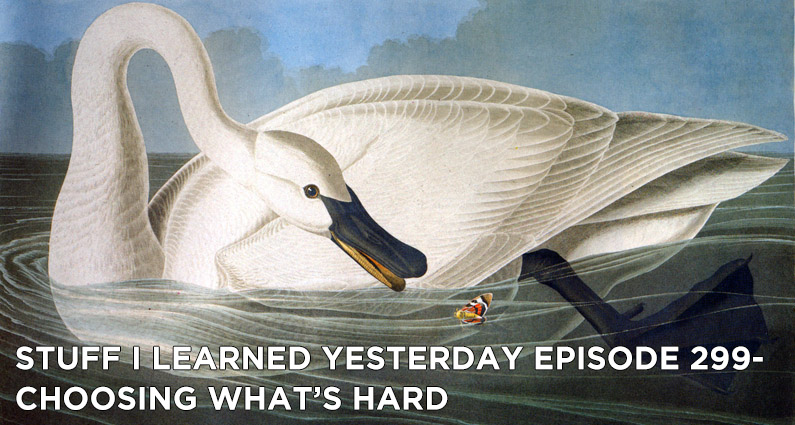
Before we decided to visit the museum, I checked out their website. The website informed me that the museum had a temporary exhibit called Audubon and the Art of Birds that told the story of John James Audubon and featured some of his artwork. This exhibit did not seem interesting at all. I could not have been more wrong.
Because of its location within the museum, the Audubon exhibit was the last thing we saw that day. I found the story of John James Audubon to be fascinating and his work even more captivating.
John James Audubon was born April 26, 1785 in what is now known as Haiti. His mother died when he was less than a year old and he grew up in France. To avoid being conscripted into Napoleon’s army, his dad shipped him off to the United States. Once there, his story took a very interesting turn.
His father had purchased a home and land just outside of Philadelphia. He eventually met a woman named Lucy, and they married. Immediately after getting married they boarded a steamboat and headed west to Louisville, Kentucky.
They had a very good life in Louisville. He ran two different general stores and provided a very comfortable living for their family. They had four children altogether, 2 boys and 2 girls. Their daughter, Lucy, died at the age of 2 and their daughter, Rose, died at 9 months.
Even though John was providing a very nice living for his family with his stores, his passion was elsewhere. His passion was with birds.
His passion for birds had begun when he was younger. He would spend hours walking through the French countryside observing and killing birds. He took care to kill the birds in a way that cause the least damage to them so he could observe them more closely and draw them. At first his drawings were stiff and lifeless.
After a time in Louisville, he had to follow his passion. With his wife’s approval, he headed out to explore the American frontier. His goal was to observe and draw every single bird in America. He wrote to her often and shared details of his journey. When he finally returned, he had a body of work that was unlike anything ever seen.
He took his drawings to Philadelphia to get them published, but no one was interested. By this time his money was nearly gone. As a last resort, he boarded a ship to England to find a buyer.
The response in England was vastly different than in Philadelphia. His work was praised almost instantly. He quickly found a publisher and work began to create what we now know as Birds of America.
Birds of America is big. No, it’s massive. Audubon made his drawings life size. That may not seem like a big deal for a blue jay or cardinal, but it is for a turkey or eagle. Some of the paintings were 39 inches by 26 inches.
Taking Audubon’s work and turning them into a book was no small task. Keep in mind that it was 1827.
Audubon’s art was first traced by an artist. Those tracings were then transferred to a copper plate in a manner similar to the way today’s tattoo artists transfer an outline to the place they are going to put the tattoo. Then another artist meticulously carved the traced drawing into a large copper plate. After the copper plate received an acid bath, it was ready to use.
The copper plate was put into a printing press where it was used to create a black and white drawing that had the outline and shading of the bird. No color was done by printing press. Instead all of the color was added by hand. 40-50 color artists worked tirelessly to apply color to each of Audubon’s drawings. In total there were 435 plates. 185 completed copies were made and it took 13 years to complete the process for making the book.
According to the video documentary they played at the exhibit, Audubon was an overnight success.
Here’s what I learned.
There is so much more to this story that I can share on this podcast. If what I’ve shared sounds interesting, I encourage you to check out the PBS Documentary of John James Audubon that is available on Youtube or by checking out his drawings at Audubon.org.
What you’ll see is that Audubon did not become a world renowned artist overnight. He spent an entire lifetime honing his craft. He not only had to be able to draw details, but he had to be a keen observer. He also had to invent a way of posing the birds so they could appear alive in his drawings.
Audubon used pencil, ink, pastels, chalk, graphite, and watercolor to create his masterpieces. While his originals were stunning, they had to be recreated for the world. That process took a team of over 50 people.
I know what the documentary meant when it said that Audubon was an overnight success, but the truth is he was far from it. It took him a lifetime to achieve his dream and the success he was hoping for. He was 53 years old when Birds of America was finally completed.
So I learned to keep following my passion. True passion will fuel itself. Audubon would get up at 3am, head to the field, gather specimens, and spend the afternoon drawing them. He would then head back out to make more observations and then draw late into the night. His passion fueled him.
I learned that no one achieves success alone. If you look at anyone who has achieved success, you’ll see a support team around them. Not only did Audubon rely on other world-class artists, he relied on the support from his wife, Lucy.
Lastly, I am reminded that it’s short sighted to look at other’s success and see it as easy or quick. One observer could look at the fact that Audubon arrived in London and instantly sold his work as an indicator that his success was easy and quick. Obviously that would be an incredibly short-sighted conclusion.
Success is almost never quick, and certainly almost never easy. I think JFK said it best in his Moon Speech. He said, “We choose to go to the moon. We choose to go to the moon in this decade and do the other things, not because they are easy, but because they are hard, because that goal will serve to organize and measure the best of our energies and skills, because that challenge is one that we are willing to accept, one we are unwilling to postpone, and one which we intend to win.”
Keep pushing yourself. Keep at your goals. Keep honing your craft. Keep looking for someone to believe in you. Don’t give up. It’s never easy. It’s never quick. But it’s worth it.
I’m Darrell Darnell and this has been Stuff I Learned Yesterday.
Send in your contributions for this week’s Friday Forum. Head on over to https://www.goldenspiralmedia.com/feedback and use the form on that page to submit your written or audio message. You can also use the Speakpipe widget to record something using your devices microphone. And of course you can call our voice feedback line at 304-837-2278. We’d love to hear from you.
Join our Facebook Group at Facebook.com/groups/stuffilearnedyesterday.
You can Follow Golden Spiral Media on Twitter at GSMPodcasts and Facebook.com/GoldenSpiralMedia. If you’ve enjoyed this episode of Stuff I Learned Yesterday, I would be grateful if you’d leave a review in iTunes.
[sc:stuff]