
Podcast: Play in new window | Download (Duration: 12:48 — 7.7MB) | Embed
Can I tell you something a little embarrassing?
Years ago when I first started podcasting, I would constantly look at the download numbers and as I was pulling them up, I’d get butterflies in my stomach. Downloads up, good day. Downloads down, bad day. I’d refresh the analytics page like it was going to tell me something about my worth as a human being. I eventually saw past that trap and rarely gave my podcasts stats much thought or weight. But last year, I fell back into that trap again.
Welcome to Stuff I Learned Yesterday, this is episode #717, “The Scorecard Trap.” I’m Darrell Darnell, the all-time downloads for podcasts that I’ve personally hosted is somewhere between 2.5 and 3 million, and I believe that if you aren’t learning, you aren’t living.
Does that seem like a lot? Those downloads are stretched across 16 different podcasts and I can’t give you an exact number because some of our stats were lost quite a while ago. But I think it’s a good number. It’s a good number because each one of those downloads represents an individual connection with someone like you.
But podcast downloads are a funny thing.
When you become a podcaster nobody sits you down and says, “the way you measure whether this show matters is downloads.” Yet for most podcasters, that’s exactly what happens. Every podcasting blog, every conference, every conversation with other podcasters, it’s always the same question. “How many downloads you getting?” Nobody asks, “Did anybody’s Monday get a little better because of something you said?” Nobody asks, “Did you help one person feel less alone this week?” So the download number becomes the scorecard, not because it’s the thing that matters most, but because it’s the thing everybody else is already using. It’s an easy metric to find and track. It feels official. It feels like the real measuring stick, even when you know, deep down, it isn’t.
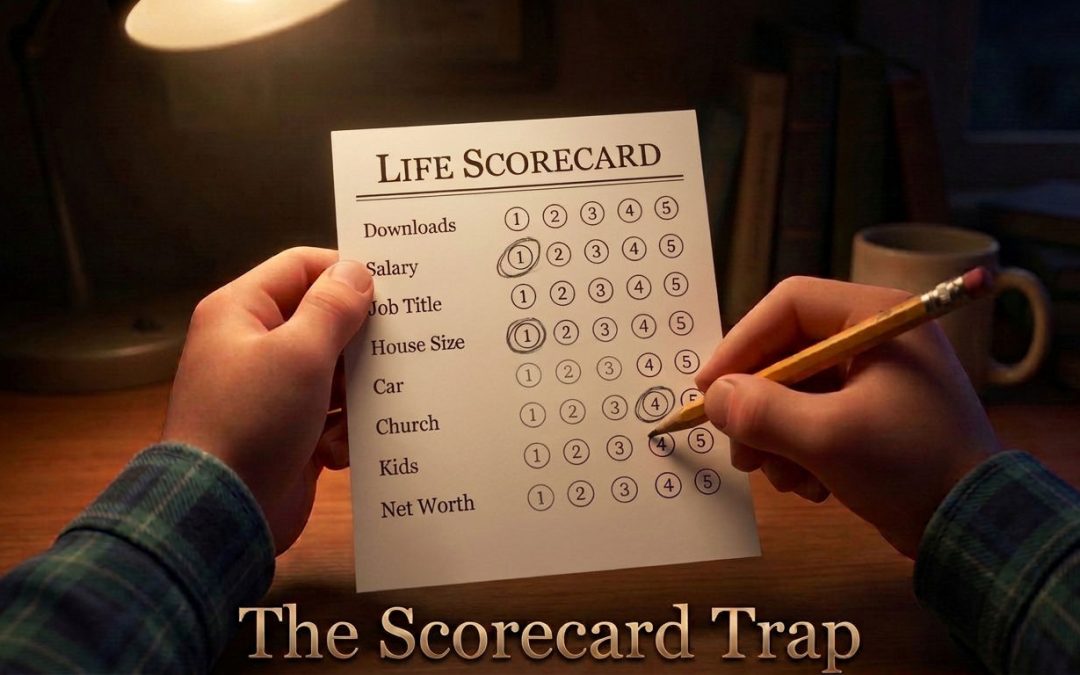
And that got me thinking about scorecards in general. We all have them. Little internal rubrics we use to decide if we’re winning or losing at life. And the strange part is, almost nobody sits down and consciously chooses their own scorecard. We just inherit one. From our family. From our industry. From comparison. From whoever happened to hand us an unspoken rubric before we were old enough to question it.
And once you have that scorecard in hand, you start grading your whole life against it, even if it’s the wrong test.
That’s exactly what happened to a guy named George Bailey.
If you’ve never seen It’s a Wonderful Life, here’s the setup. It’s a film from 1946, but it’s become a Christmas classic that most of us have seen. You may watch it every year as part of a Christmas tradition. There are a lot of lessons we can glean from it, but today’s lesson has nothing to do with the holiday and everything to do with scorecards.
George Bailey grows up in a small town called Bedford Falls with big dreams. He wants out. He wants to travel the world, build bridges and skyscrapers, make something of himself on a grand scale. Instead, life keeps handing him reasons to stay. His father dies, so he steps in to run the family’s tiny building and loan company instead of going to college like he planned. His brother gets the scholarship and the escape George wanted for himself. A wealthy, greedy man named Mr. Potter keeps trying to buy out or crush the Bailey building and loan, and George keeps sacrificing his own plans to protect it, because if it goes under, half the town loses their homes to Potter.
Fast forward years later. George is married, has kids, still running that same small company, still in that same small town. Then on Christmas Eve, they realize a large sum of money has gone missing due to an honest mistake made by George’s absent-minded uncle. Suddenly George is staring down fraud charges and financial ruin. In a moment of complete despair, believing he’s worth more to his family dead than alive, he ends up standing on a bridge in the freezing cold, ready to jump into the river.
That’s when Clarence shows up. Clarence is George’s guardian angel, and he’s been sent to talk George out of it. So Clarence does something clever. He shows George what Bedford Falls would look like if George had never been born at all.
And it turns out that without George, it’s not a nicer town. It’s a nightmare. Without George, his little brother drowned in a childhood accident, because George wasn’t there to save him. Without George, the town isn’t Bedford Falls anymore, it’s Pottersville, a cold, corrupt, joyless place, because Mr. Potter ran wild with nothing to stop him. The pharmacist George once saved from making a fatal error while grieving ends up in prison. George’s own wife never married, and lives a lonely, fearful life. Every single person George thought he’d failed by not becoming rich or famous, every one of them is dramatically worse off without him.
George never actually failed. He just spent his whole life using the wrong scorecard. He was grading himself on wealth, fame, and how far he traveled from home, when the real scorecard, the one that actually mattered, was made up of things like: a brother alive, friends who kept their homes, a town that stayed decent, a family that loved him. By that scorecard, he wasn’t just passing. He was one of the richest men in town.
I find it easy to relate to that bridge scene, because when I take time to examine myself, I see that I’ve spent stretches of my own life measuring myself with rulers I never actually picked up on purpose.
The first scorecard I inherited without realizing it was around faith.
Somewhere along the way, I absorbed the idea that spiritual growth basically meant three things: how often you’re at church, how much Bible trivia you can recite, and how visibly “on fire” your faith looks to other people. If you’re leading something, teaching something, posting something spiritual, you’re winning. If your prayer life looks quiet and ordinary, you must be losing.
What I’ve had to relearn, slowly and imperfectly, is that God never handed me that scorecard. That one came from church culture, from comparing myself to people who seemed more put together, from confusing activity with intimacy. The scorecard I’m trying to use now is a lot less impressive to watch from the outside. It’s things like, am I quicker to be honest with God when I’m struggling instead of performing peace I don’t feel? Am I becoming more patient with my family behind closed doors, where nobody’s watching? That’s a much harder scorecard to fake, and honestly, a much better one to actually grow by.
The second scorecard showed up in how I define being a good husband and father.
The inherited version of that scorecard, at least for me, was mostly about provision and achievement. Are the bills paid? Is the house nice enough? Are the kids doing well in school, involved in the right activities, keeping up with the other families we know? It’s an easy scorecard to slide into, because it’s measurable and comparable, and comparison is basically a full time hobby if you let it be. It’s easy to slide into that trap of buying things we don’t want to impress people we don’t like.
Here’s what I’m trying to measure instead. Not “did I provide enough,” but “was I actually there.” Not “are my kids impressive,” but “do my kids feel safe telling me the truth.” “Is the relationship I have with my wife and kids authentic.” Presence over provision. Relationship over resume. It’s a quieter scorecard. Nobody hands out an award for it. But it’s the one that will still matter twenty years from now, when nobody remembers what car we drove or what grades got posted on the fridge.
And that brings us back around to where we started, downloads.
For a long time, my career scorecard, especially with this show, The Fringe Podcast, and with Golden Spiral Media, was almost entirely external. Downloads. Growth numbers. How the show compared to other shows. Whether I was scaling fast enough, building something big enough, proving myself successful enough by industry standards I never actually sat down and agreed to.
What I’ve landed on, and this is still a work in progress, is that the scorecard I actually want to use for this show has almost nothing to do with the metrics everyone else watches. It’s things like, did this episode help one person have a harder, more honest conversation with their spouse this week. Did it give someone language for something they’d been feeling but couldn’t quite name. Did it make one person feel a little less alone at night when they couldn’t sleep and needed something in their ears. Did it help someone understand God better or make the world a better place. Those things don’t show up on a dashboard. But they’re the entire reason I do this.
Here’s what I learned.
Time and time again when I take time to look at what matters and set aside the scorecard that so easily entraps me, I realize the same thing George Bailey learned on that bridge. Almost none of us consciously chose the scorecard we’re using right now. We inherited it. From our industry, our upbringing, our culture, our own insecurities dressed up as ambition.
The invitation this week is simple, but it’s not easy. In each major area of your life, faith, family, career, whatever else matters to you, ask yourself one question. What scorecard am I using, and did I ever actually choose it?
If the honest answer is no, you inherited it without thinking about it, that’s not a failure. That’s just where most of us start. But it does mean you get to do something George Bailey never got the chance to do until he was standing on a bridge in the middle of a breakdown. You get to choose your scorecard on purpose, before the crisis forces you to.
You might find out, like George did, that you were never actually losing. You were just keeping score wrong.
I’m Darrell Darnell, and this has been Stuff I Learned Yesterday.
I want you to be a part of the next Monday Mailbag on November 30th! Monday Mailbag is your opportunity to share what YOU’VE learned, so that other listeners and I can learn from YOU. It can be a message as short as 30 seconds or several minutes long. It really doesn’t matter just as long as it’s something that will benefit others. You can send in questions or responses to my SILY episodes, and I’ll respond to them via Monday Mailbag episodes. You can participate in Monday Mailbags by visiting the Golden Spiral Media listener feedback page at goldenspirlamedia.com/feedback.